 |
| The Council of Trent (From: Wikipedia) |
Showing posts with label 16th Century. Show all posts
Showing posts with label 16th Century. Show all posts
Sunday, January 10, 2016
Say "Justification by Faith", or I Pull Your Beard!

Friday, December 25, 2015
"Direct Revelation" Says: No Immaculate Conception
"Berne [Switzerland] was the theater of one of the most reverberating scandals enacted by the contemporary church. A passionately contested theological issue of the day was whether the Virgin had been immaculately conceived. This was denied by the Dominicans and asserted by the Franciscans. Some of the Dominicans of the friary at Berne thought that the best way to settle the affair was to have a direct revelation. For their fraudulent purposes they conspired with John Jetzer, a lay brother admitted in 1506, who died after 1520. Whether as a tool in the hands of others, or as an imposter, Jetzer produced a series of bogus apparitions, bringing the Virgin on the stage and making her give details of her conception sufficiently gross to show that it took place in the ordinary, and not in the immaculate, manner. When the fraud was at last discovered by the authorities, four of the Dominicans involved were burnt at the stake." (121) --Preserved Smith, Reformation in Europe
Saturday, September 6, 2014
Pass Some of that Spicy Sauce, Please!
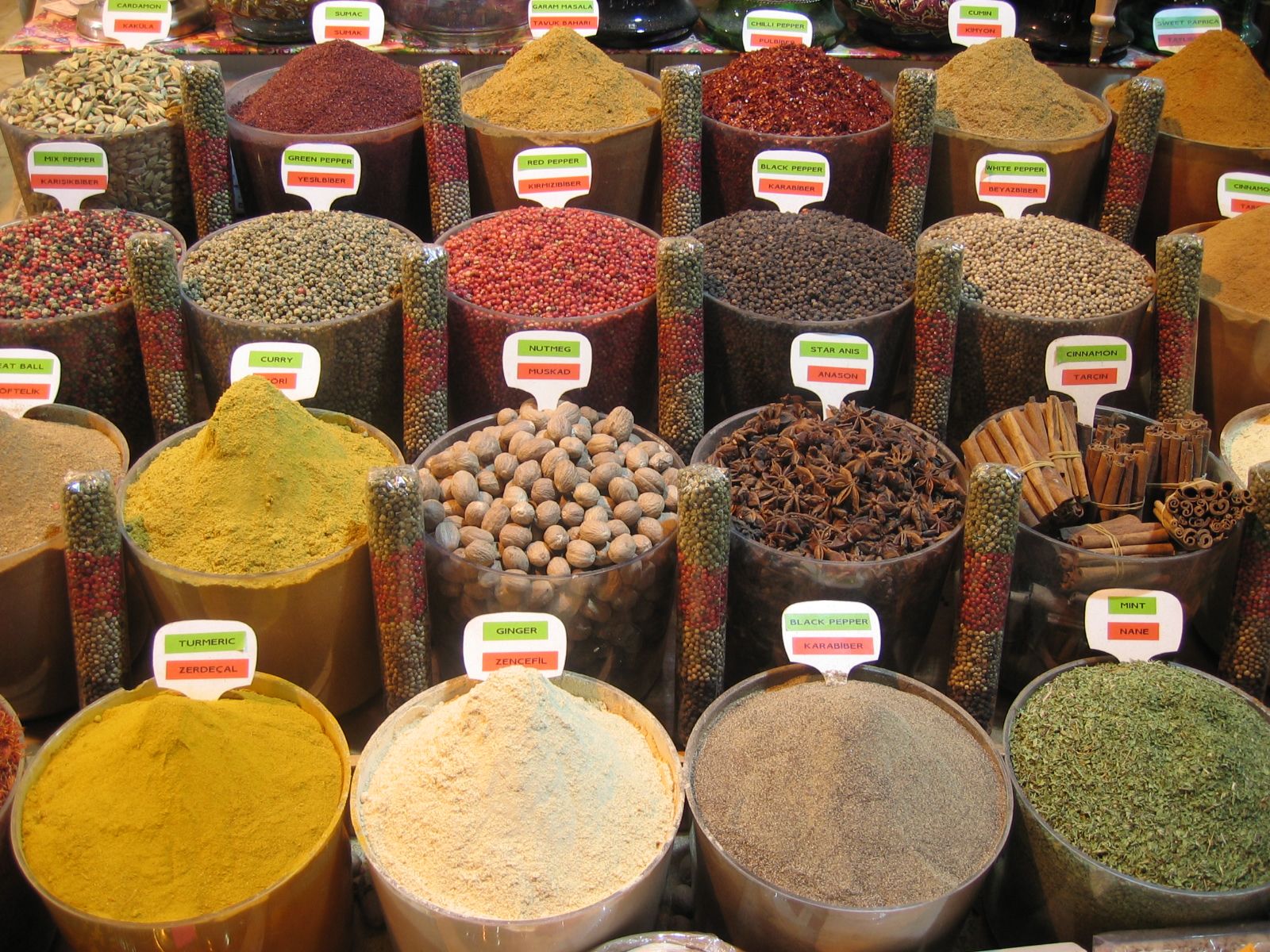 |
| A spice market in Istanbul. (From: Wikipedia) |
I might also add that medieval Europeans had no tomatoes. Tomatoes are native only to South America. So, for hundreds and hundreds of years before the 16th century, Italian cooks had no tomatoes!
Friday, August 15, 2014
The Real Meaning of "Manhattan"
 |
| Oak-Hickory Forest (From: Wikipedia) |
The Mannahatta Project, which reconstructs the natural history of Manhattan as of 1609, has spread the claim that the name used by the local Lenape Indians was Mannahatta and meant 'island of many hills.' In fact, the spelling 'Mannahatta' is taken from a poem by Walt Whitman and does not mean in any spelling 'island of hills' let alone 'island of many hills'..." (287) --Ives Goddard, "The Origin and Meaning of the Name 'Manhattan,'" New York History, Vol. 91, No. 4 (Fall 2010)
Goddard bolsters his argument as to the incorrectness of both of the above proposed meanings (and others) with extended historical and linguistic arguments. So, what does "Manhattan" mean, according to Goddard? The original Native American inhabitants of Manhattan were Munsees. Their language was Munsee, part of the major linguistic group of Algonquins. Goddard locates the meaning of "Manhattan" as they themselves used it by focusing on the report of Albert Anthony, a 19th century Munsee Indian living on a reservation in Ontario. Anthony provided the Munsees' traditional explanation of "Manhattan" (the following is a quote of Anthony):
"Our traditions affirm that at the period of the discovery of America, our Nation resided on the Island of New York. We call that island Man-a-ha-tonh, The place where timber is procured for bows and arrows. The word is compounded of N'man-hum-in, I gather, and tan-ning, at the place. At the lower end of the island was a grove of hickory trees of peculiar strength and toughness. Our fathers held this timber in high esteem as material for constructing bows, war-clubs, etc." (289)
I am always fascinated to read about the natural history of Manhattan before the European exploration. The contrast between the current and pre-European landscapes could not be greater. The natural order here is almost completely obliterated. Think of it: a grove of hickory trees in lower Manhattan. Amazing!
Subscribe to:
Posts (Atom)