Showing posts with label Philadelphia. Show all posts

Thursday, October 8, 2015

A Federal Office of Peace

Benjamin Rush, a Philadelphia physician and American founding father (he signed the Declaration of Independence), wrote an essay in the late-18th century entitled "A Plan of a Peace-Office for the United States." He gives several arguments for a new federal office of peace, then proceeds to describe the physical quarters of the peace office--as well as those of the federal office of war.

"In the last place, let a large room, adjoining the federal hall, be appropriated for transacting the business and preserving all the records of this office. Over the door of this room let there be a sign, on which figures of a LAMB, a DOVE and an OLIVE BRANCH should be painted, together with the following inscriptions in letters of gold:

PEACE ON EARTH--GOOD-WILL TO MAN.
AH! WHY WILL MEN FORGET THAT THEY ARE
BRETHREN?

Within this apartment let there be a collection of ploughshares and pruning-hooks made out of swords and spears; and on each of the walls of the apartment, the following pictures as large as the life:
1. A lion eating straw with an ox, and an adder playing upon the lips of a child.
2. An Indian boiling his venison in the same pot with a citizen of Kentucky.
3. Lord Cornwallis and Tippoo Saib, under the shade of a sycamore-tree in the East Indies, drinking Madeira wine together out of the same decanter. 
4. A group of French and Austrian soldiers dancing arm in arm, under a bower erected in the neighborhood of Mons. 
5. A St. Domingo planter, a man of color, and a native of Africa, legislating together in the same colonial assembly. 
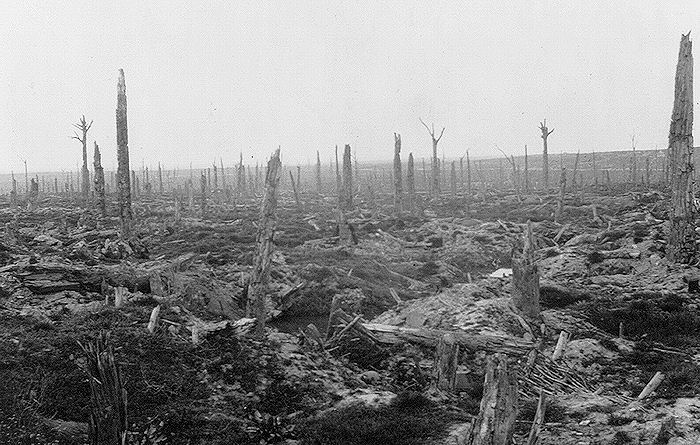
A former forest at Flanders Field in Belgium, after repeated
artillery shellings during World War I.
(From: TheHistoryPlace)
To complete the entertainment of this delightful apartment, let a group of young ladies, clad in white robes, assemble every day at a certain hour, in a gallery to be erected for the purpose, and sing odes, and hymns, and anthems in praise of the blessings of peace. 

One of these songs should consist of the following lines.


Peace o'er the world her olive wand extends,
And white-rob'd innocence from heaven descends;
All crimes shall cease, and ancient frauds shall fail, 
Returning justice lifts aloft her scale.

In order more deeply to affect the minds of the citizens of the United States with the blessings of peace, by contrasting them with the evils of war, let the following inscriptions be painted upon the sign, which is placed over the door of the War Office.
1. An office for butchering the human species. 
2. A Widow and Orphan making office.
3. A broken bone making office.
4. A Wooden leg making office.
5. An office for creating public and private vices. 
6. An office for creating a public debt. 
7. An office for creating speculators, stock Jobbers, and Bankrupts. 
8. An office for creating famine.
9. An office for creating pestilential diseases. 
10. An office for creating poverty, and the destruction of liberty, and national happiness. 

In the lobby of this office let there be painted representations of all the common military instruments of death, also human skulls, broken bones, unburied and putrifying dead bodies, hospitals crouded with sick and wounded Soldiers, villages on fire, mothers in besieged towns eating the flesh of their children, ships sinking in the ocean, rivers dyed with blood, and extensive plains without a tree or fence, or any other object, but the ruins of deserted farm houses. 

Above this group of woeful figures,--let the following words be inserted, in red characters to represent human blood, 

'NATIONAL GLORY'"

--Benjamin Rush, "A Plan of a Peace-Office for the United States." Essays, Literary, Moral and Philosophical


Sunday, October 4, 2015

A Slippery Slope from Latin Lesson Avoidance to a Life of Crime

Benjamin Rush (From: Wikipedia)
"Many sprightly boys of excellent capacities for useful knowledge, have been so disgusted with the dead languages, as to retreat from the drudgery of schools, to low company, whereby they have become bad members of society, and entailed misery upon all who have been connected with them." (24)
--Benjamin Rush, "Observations Upon the Study of the Latin and Greek Languages..." Essays, Literary, Moral and Philosophical

Benjamin Rush, you will recall, is one of the founding fathers, having signed the Declaration of Independence. He was a physician from Philadelphia, Pennsylvania. His entire essay on the dead languages, published in the above collection in 1798, is an argument for why students up to the age of eighteen should not study Latin and Greek. The crux of his argument is that knowledge of these languages is not "useful." The only time when Greek was useful, he says, was when Greek children were learning it in their ancient schools. He brings all the argumentative ammunition he can summon to his task, including more unlikely propositions such as the one above.

Saturday, May 4, 2013

"Flatulent Preachments" and More Political Pamphlet Fun

"As the battle thickened, pamphleteers reached new pinnacles of abuse and scurrility. [Benjamin] Franklin was reviled as an intellectual charlatan who begged and bought honorary degrees in England, a corrupt politician, and a lecherous old man. His friends responded by labeling an opposition pamphleteer 'a Reptile' who 'like a Toad, by the pestilential Fumes of his virulent Slabber,' attempted 'to blast the fame of a PATRIOT.' William Smith, coordinator of the opposition [and an Anglican minister], was advertised to be a 'consumate Sycophant,' an 'indefatigable' liar, and an impudent knave with a heart 'bloated with infernal Malice' and a head full of 'flatulent Preachments.' As for the Presbyterians, a Franklinite pamphleteer renamed them 'Piss-Brute-tarians (a bigotted, cruel and revengeful sect).'

The more scabrous the literature became the more widely it was distributed, often gratis, to all who would accept it. Before the campaign was over, more than thirty-five broadsides and pamphlets, not to mention scores of newspaper fusillades, filled the streets. Chief Justice William Allen, a man who had risen from sugar boiler to wealthy merchant, found himself called 'Old Drip-pan,' an adulterer who had slept with his Negro slaves for twenty years, and 'a tricking Judge, and Presbyterian Jew.' The pamphleteer David Dove stood accused of sodomy, misogyny, miscegenation, concupiscence, and the almost unheard-of flaw of teratology. William Smith was charged with spreading venereal disease to his female slaves, and Franklin too was charged with sexual irregularities." (179-180) --Gary B. Nash, The Urban Crucible: The Northern Seaports and the Origins of the American Revolution
William Smith
From: University of Pennsylvania
Archives & Records Center


This all occurred in the months leading up to an October 1764 election in Pennsylvania. Franklin was allied with the Quaker elite in seeking to transfer Pennsylvania government from proprietary to royal control. Believe it or not, the Pennsylvania colony at this late date still existed for the personal profit of William Penn's descendants, including Thomas Penn. Penn insisted on his proprietary right to not pay property taxes on the large quantities of Pennsylvania land he owned--this at a time when the colony was having difficulty paying its debts from the French and Indian War. Franklin's solution to the problem of proprietary control was to transfer control of the colony's government to the king.

The early 1760s was a poor time for Franklin to attempt this as Pennsylvania colonists were suffering under the harsh economic effects of many imperial policies, not to mention of post-war depression. There was talk of a new stamp tax (the Stamp Act was passed in 1765); the Currency Act (1764) had just prohibited Pennsylvania from circulating paper money to help pay its war debts; violators of the Navigation Acts (viz., smugglers) were now being prosecuted from a distance by British judges, not local juries; and British battleships were stationed in the lower Delaware Bay tasked with searching for smuggled goods. All of these royal measures brought even more economic hardship to Philadelphia (described on p.179 of Nash's book). This was not the most ideal time for Franklin to propose a transfer of Pennsylvania government to royal control! But we can thank Franklin for inspiring some of the most entertaining political nastiness to ever exist (to my knowledge anyway; how could it get any worse?!).

*By the way, if you're wondering what "teratology" means, according to Dictionary.com: "the science or study of monstrosities or abnormal formations in organisms."

Thursday, May 2, 2013

Ben Franklin's "Rottiness of Heart"

"...by 1754 the antiexcise pamphleteers in Boston were painting images of the opponents as 'Little pestilent Creature[s],' 'dirty miscreants,' and unspeakably horrible creatures ready to 'cram [their]... merciless and insatiable Maw[s] with our very Blood, and bones, and Vitals,' while making sexual advances on wives and daughters." (125)

"When the imperious Anglican clergyman William Smith attacked Benjamin Franklin, the artisans' hero, his opponents wrote that 'the Vomiting of this infamous Hireling... betoken[s] that Redundancy of Rancour, and Rottiness of Heart which render him the most despicable of his Species." (125)
--both quotes from Gary B. Nash, The Urban Crucible: The Northern Seaports and the Origins of the American Revolution
Benjamin Franklin
From: Wikimedia Commons, Metropolitan Museum of Art


Nash describes the increasingly virulent, shrill political discourse that appeared in pamphlets and newspapers of the northern colonies in the 1750s. Regular newspapers had only existed for around half a century at this point. In the early 1700s, those who attacked political opponents in newspapers were more polite, using words like "intolerable," "unreasonable," and "strange." (Nash, 125) The shift in tone by political writers of the 1750s coincided with a shift in how explicit political factions and interests were viewed. Previously, the existence of groups unified by and advocating for a specific political interest was seen as destructive of the common good; a healthy state required more unity. However, in the mid-1700s a view that competing political factions could produce a healthy power balance in the state and that it was morally acceptable to act politically for one's self-interest had gained momentum. Once it became acceptable to identify oneself with a political interest group and oppose other such groups, a steady escalation in the intensity of public criticism occurred. The criticism was all the more severe as writers pitched their most convincing arguments to a slowly growing population of voters caused by widening suffrage laws. Given these circumstances, we should not be surprised to learn of Benjamin Franklin's "Rottiness of Heart."  

Monday, April 15, 2013

The Gentlemens' Gunfight

"In Philadelphia, class warfare nearly broke out as genteel men exchanged gunfire with crowds of the "lower sort." The most alarming incident was a 1779 showdown between the Philadelphia militia and a lawyer named James Wilson, who was suspected of wartime profiteering and aiding the British. Upon hearing a rumor that a scheduled march by the Philadelphia militia was actually a plot to arrest Wilson for treason, the lawyer assembled a group of armed gentlemen at his home. When the militia paraded by, someone inside fired a shot into the crowd. A gunfight ensued, and by the time the shooting had ended, several militiamen and a few gentlemen lay dead. (Wilson would survive to become one of the primary architects of the new federal Constitution designed to remove power from the hands of ordinary people such as these.)" --Terry Bouton, TAMING DEMOCRACY: "THE PEOPLE," THE FOUNDERS, AND THE TROUBLED ENDING OF THE AMERICAN REVOLUTION

In addition to his activity at the Constitutional Convention in 1787, Wilson also later became a Supreme Court justice. Wilson was one of our Founding Fathers!