Showing posts with label Pennsylvania. Show all posts

Thursday, October 8, 2015

A Federal Office of Peace

Benjamin Rush, a Philadelphia physician and American founding father (he signed the Declaration of Independence), wrote an essay in the late-18th century entitled "A Plan of a Peace-Office for the United States." He gives several arguments for a new federal office of peace, then proceeds to describe the physical quarters of the peace office--as well as those of the federal office of war.

"In the last place, let a large room, adjoining the federal hall, be appropriated for transacting the business and preserving all the records of this office. Over the door of this room let there be a sign, on which figures of a LAMB, a DOVE and an OLIVE BRANCH should be painted, together with the following inscriptions in letters of gold:

PEACE ON EARTH--GOOD-WILL TO MAN.
AH! WHY WILL MEN FORGET THAT THEY ARE
BRETHREN?

Within this apartment let there be a collection of ploughshares and pruning-hooks made out of swords and spears; and on each of the walls of the apartment, the following pictures as large as the life:
1. A lion eating straw with an ox, and an adder playing upon the lips of a child.
2. An Indian boiling his venison in the same pot with a citizen of Kentucky.
3. Lord Cornwallis and Tippoo Saib, under the shade of a sycamore-tree in the East Indies, drinking Madeira wine together out of the same decanter. 
4. A group of French and Austrian soldiers dancing arm in arm, under a bower erected in the neighborhood of Mons. 
5. A St. Domingo planter, a man of color, and a native of Africa, legislating together in the same colonial assembly. 
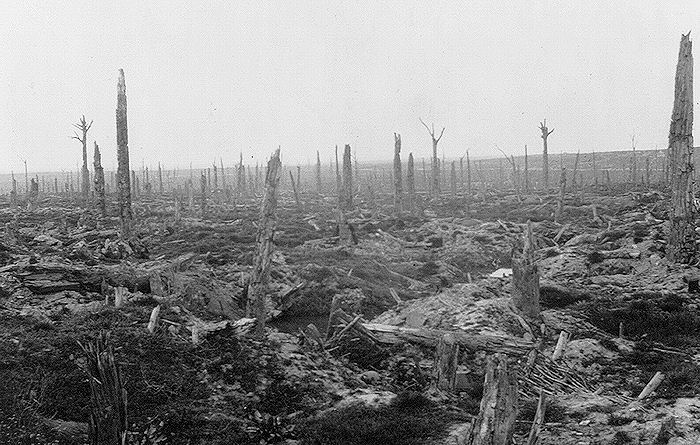
A former forest at Flanders Field in Belgium, after repeated
artillery shellings during World War I.
(From: TheHistoryPlace)
To complete the entertainment of this delightful apartment, let a group of young ladies, clad in white robes, assemble every day at a certain hour, in a gallery to be erected for the purpose, and sing odes, and hymns, and anthems in praise of the blessings of peace. 

One of these songs should consist of the following lines.


Peace o'er the world her olive wand extends,
And white-rob'd innocence from heaven descends;
All crimes shall cease, and ancient frauds shall fail, 
Returning justice lifts aloft her scale.

In order more deeply to affect the minds of the citizens of the United States with the blessings of peace, by contrasting them with the evils of war, let the following inscriptions be painted upon the sign, which is placed over the door of the War Office.
1. An office for butchering the human species. 
2. A Widow and Orphan making office.
3. A broken bone making office.
4. A Wooden leg making office.
5. An office for creating public and private vices. 
6. An office for creating a public debt. 
7. An office for creating speculators, stock Jobbers, and Bankrupts. 
8. An office for creating famine.
9. An office for creating pestilential diseases. 
10. An office for creating poverty, and the destruction of liberty, and national happiness. 

In the lobby of this office let there be painted representations of all the common military instruments of death, also human skulls, broken bones, unburied and putrifying dead bodies, hospitals crouded with sick and wounded Soldiers, villages on fire, mothers in besieged towns eating the flesh of their children, ships sinking in the ocean, rivers dyed with blood, and extensive plains without a tree or fence, or any other object, but the ruins of deserted farm houses. 

Above this group of woeful figures,--let the following words be inserted, in red characters to represent human blood, 

'NATIONAL GLORY'"

--Benjamin Rush, "A Plan of a Peace-Office for the United States." Essays, Literary, Moral and Philosophical


Sunday, October 4, 2015

A Slippery Slope from Latin Lesson Avoidance to a Life of Crime

Benjamin Rush (From: Wikipedia)
"Many sprightly boys of excellent capacities for useful knowledge, have been so disgusted with the dead languages, as to retreat from the drudgery of schools, to low company, whereby they have become bad members of society, and entailed misery upon all who have been connected with them." (24)
--Benjamin Rush, "Observations Upon the Study of the Latin and Greek Languages..." Essays, Literary, Moral and Philosophical

Benjamin Rush, you will recall, is one of the founding fathers, having signed the Declaration of Independence. He was a physician from Philadelphia, Pennsylvania. His entire essay on the dead languages, published in the above collection in 1798, is an argument for why students up to the age of eighteen should not study Latin and Greek. The crux of his argument is that knowledge of these languages is not "useful." The only time when Greek was useful, he says, was when Greek children were learning it in their ancient schools. He brings all the argumentative ammunition he can summon to his task, including more unlikely propositions such as the one above.

Monday, June 16, 2014

Those Tricky Englishmen

Map of Delaware River (From: Wikimedia)
"In 1737, with English settlers advancing into Delaware Indian country and the Delawares grudgingly giving ground, a novel agreement was reached: The Indians would let white men inhabit the land along the Delaware River as far upstream as a man could walk in a day and a half. The Indians had in mind a normal pace; the whites did not. Thomas Penn, descendant of the founder of Pennsylvania, selected three young athletes, had them secretly reconnoiter a trail, and promised 5 [pounds] and 500 acres to the man who walked the farthest. Edward Marshall covered more than 65 miles in the allotted time--about twice the distance the Delawares had anticipated. They never forgot nor forgave the Englishmen's stratagem." (116) --Ronald M. Fisher, The Appalachian Trail

Saturday, May 4, 2013

"Flatulent Preachments" and More Political Pamphlet Fun

"As the battle thickened, pamphleteers reached new pinnacles of abuse and scurrility. [Benjamin] Franklin was reviled as an intellectual charlatan who begged and bought honorary degrees in England, a corrupt politician, and a lecherous old man. His friends responded by labeling an opposition pamphleteer 'a Reptile' who 'like a Toad, by the pestilential Fumes of his virulent Slabber,' attempted 'to blast the fame of a PATRIOT.' William Smith, coordinator of the opposition [and an Anglican minister], was advertised to be a 'consumate Sycophant,' an 'indefatigable' liar, and an impudent knave with a heart 'bloated with infernal Malice' and a head full of 'flatulent Preachments.' As for the Presbyterians, a Franklinite pamphleteer renamed them 'Piss-Brute-tarians (a bigotted, cruel and revengeful sect).'

The more scabrous the literature became the more widely it was distributed, often gratis, to all who would accept it. Before the campaign was over, more than thirty-five broadsides and pamphlets, not to mention scores of newspaper fusillades, filled the streets. Chief Justice William Allen, a man who had risen from sugar boiler to wealthy merchant, found himself called 'Old Drip-pan,' an adulterer who had slept with his Negro slaves for twenty years, and 'a tricking Judge, and Presbyterian Jew.' The pamphleteer David Dove stood accused of sodomy, misogyny, miscegenation, concupiscence, and the almost unheard-of flaw of teratology. William Smith was charged with spreading venereal disease to his female slaves, and Franklin too was charged with sexual irregularities." (179-180) --Gary B. Nash, The Urban Crucible: The Northern Seaports and the Origins of the American Revolution
William Smith
From: University of Pennsylvania
Archives & Records Center


This all occurred in the months leading up to an October 1764 election in Pennsylvania. Franklin was allied with the Quaker elite in seeking to transfer Pennsylvania government from proprietary to royal control. Believe it or not, the Pennsylvania colony at this late date still existed for the personal profit of William Penn's descendants, including Thomas Penn. Penn insisted on his proprietary right to not pay property taxes on the large quantities of Pennsylvania land he owned--this at a time when the colony was having difficulty paying its debts from the French and Indian War. Franklin's solution to the problem of proprietary control was to transfer control of the colony's government to the king.

The early 1760s was a poor time for Franklin to attempt this as Pennsylvania colonists were suffering under the harsh economic effects of many imperial policies, not to mention of post-war depression. There was talk of a new stamp tax (the Stamp Act was passed in 1765); the Currency Act (1764) had just prohibited Pennsylvania from circulating paper money to help pay its war debts; violators of the Navigation Acts (viz., smugglers) were now being prosecuted from a distance by British judges, not local juries; and British battleships were stationed in the lower Delaware Bay tasked with searching for smuggled goods. All of these royal measures brought even more economic hardship to Philadelphia (described on p.179 of Nash's book). This was not the most ideal time for Franklin to propose a transfer of Pennsylvania government to royal control! But we can thank Franklin for inspiring some of the most entertaining political nastiness to ever exist (to my knowledge anyway; how could it get any worse?!).

*By the way, if you're wondering what "teratology" means, according to Dictionary.com: "the science or study of monstrosities or abnormal formations in organisms."

Monday, April 29, 2013

A Sow's Arse

"An anonymous [Philadelphia] pamphleteer, styling himself 'Roger Plowman' in a 'letter' to 'Mr. Robert Rich,' began to dig deeper into the economic motives of those who opposed paper money: 'the principal Reason why you are angry with Paper-money, is because People who are in your Debt can raise money to pay you, without surrendering up their Lands for one half of what they are worth.' [James] Logan [a leading Philadelphia conservative politician of the 1720s] had argued that without the rich, the poor would always be poor. 'Roger Plowman' reversed the proposition, suggesting that because of the rich, the poor would remain poor. 'It is an old Saying with us,' he wrote, 'that we must never grease the fat Sow in the Arse, and starve the Pigs.'" (94) --Gary B. Nash, The Urban Crucible: The Northern Seaports and the Origins of the American Revolution
"An Unpromising Drawing To Put a Joke To."
From: New York Public Library Picture Collection Online

In the 18th century before the Revolution, colonies would occasionally circulate fixed amounts of paper money. One of several ways that this could be done would be the exchange of paper money with landowners as a loan with the land serving as collateral. Having paper money made it easier for taxpayers to pay their taxes, debtors to pay their creditors, and generally exchange goods with one another. If you had only large value assets, then paper money could enable you to make small scale transactions for your necessities. But paper money was always accompanied by a fear among wealthy creditors of it becoming depreciated--and being forced to accept depreciated money from their debtors.

On the other hand, if a creditor sued a debtor for collection when paper money was scarce, a debtor's property would be auctioned off or transferred to the creditor at depreciated values. The reason for this was that an auction of debtor assets occurring in a situation of cash scarcity meant that there would be few bidders; and fewer bidders meant that the final bid would be for a lower amount. Consequently, it required more valuable assets to pay off a creditor when money was scarce. This explains Roger Plowman's assertion that without paper money, people would have to surrender "up their lands for one half of what they are worth." A wealthy creditor could get lots of money or valuable assets at bargain basement prices in a money-starved economy. Roger Plowman, of course, knew these facts well. He or his acquaintances must have been the pigs who were starved in order to grease the fat sow's (creditor) arse!

Monday, April 15, 2013

The Gentlemens' Gunfight

"In Philadelphia, class warfare nearly broke out as genteel men exchanged gunfire with crowds of the "lower sort." The most alarming incident was a 1779 showdown between the Philadelphia militia and a lawyer named James Wilson, who was suspected of wartime profiteering and aiding the British. Upon hearing a rumor that a scheduled march by the Philadelphia militia was actually a plot to arrest Wilson for treason, the lawyer assembled a group of armed gentlemen at his home. When the militia paraded by, someone inside fired a shot into the crowd. A gunfight ensued, and by the time the shooting had ended, several militiamen and a few gentlemen lay dead. (Wilson would survive to become one of the primary architects of the new federal Constitution designed to remove power from the hands of ordinary people such as these.)" --Terry Bouton, TAMING DEMOCRACY: "THE PEOPLE," THE FOUNDERS, AND THE TROUBLED ENDING OF THE AMERICAN REVOLUTION

In addition to his activity at the Constitutional Convention in 1787, Wilson also later became a Supreme Court justice. Wilson was one of our Founding Fathers!

Saturday, April 13, 2013

A Ruthless Landlord

"...in 1786, when a landlord in Cumberland County [Pennsylvania] had the local constable auction the cow and horse of a tenant farmer named William McKinney, who had fallen 10 [pounds] behind on his rent. McKinney had 'begged' his landlord to 'take hogs or grain in the ground and property of value or notes equal to cash, and spare my milch cow and my plow horse for the sake of my family.' But the landlord had refused, leaving McKinney in 'the utmost distress." Resigned to the sale of his property, McKinney hoped at least to keep court costs to a minimum. 'On the day of the sale the constable came for the property, I desired he would sell them on the premises as it was a public place,' McKinney remembered, 'but he refused to do it and drove them a mile further and sold them there, for which he charged me four shillings.' Having lost even this small concession, things looked bleak.

Then, at the auction site, a miracle seemed to happen. When the constable began the bidding, McKinney's landlord arrived and halted the auction. McKinney recalled that his landlord 'made a proposal before the public that he would buy all for me and return the goods (to me) which stopped the intended buyers from bidding.' It seemed that McKinney's landlord--the man whose lawsuit had brought matters to this disastrous end--had changed his mind and come to save the day for his tenant. Compelled by this emotional scene, the other potential buyers agreed to tender no bids so that the landlord could purchase McKinney's property at a bare minimum.

Not long after the crowd had dispersed, the miracle vanished. Despite the landlord's public promises, he kept the cow and the other possessions for himself. He had rigged the auction to keep others from bidding so he could obtain his tenant's belongings for virtually nothing. The landlord also refused to erase the 10 [pound] debt. The case continued, and on 'the orders of the landlord, the constable came eight or ten days after and sold a horse' of McKinney's." --Terry Bouton, Taming Democracy: "The People," the Founders, and the Troubled Ending of the American Revolution

There was a severe scarcity of money--either paper or specie--in American during the 1780s. Despite the fact that the British government had always ensured a trade deficit with America, such that more gold and silver left America than went into it, such trade ensured that Americans saw at least some money in their economy. After the war, there was very little specie to be had anywhere. Unfortunately, many states' taxes on their citizens were payable only in specie! There wasn't even much paper money in circulation. State governments were pressured by American creditors not to print any paper money because they didn't want their debtors to pay them in inflated money--which is what almost always happened to paper money throughout the war years. Many Americans, especially in the countryside, were therefore reduced to a primitive bartering system--except when it came time to pay creditors and the government. Poor McKinney!