 |
| Continental paper money. (From: Wikipedia) |
Showing posts with label paper money. Show all posts
Showing posts with label paper money. Show all posts
Wednesday, October 16, 2013
Bum Fodder

Friday, May 10, 2013
Paper Money Is Like A Good Wife
"[John] Wise [an Ipswich, MA minister] and other writers acknowledged that commodity prices had risen since paper money came into use and that some merchants occasionally discounted public bills slightly. But, Wise pointed out, these were minor faults that the advantages attending paper money more than made up for. 'Gentlemen! You must do by your bills, as all Wise Men do by their Wives,' he noted facetiously: 'Make the best of them.' Since paper money was integral to the colonial economy, Bay Colonists would do well to 'set them High in your Estimation,' since complaints about the bills' weakness would only serve to devalue them more. He predicted that public faith, consistent policy, and a committed provincial government would eventually stabilize paper money's value in related specie." (194) --Margaret Ellen Newell, From Dependency to Independence: Economic Revolution in Colonial New England
In the first half of the 18th century in New England, one of the most contested political issues was whether and how much paper money should be issued by the colonial governments. Proponents of paper money argued that it facilitated internal trade within the colony by making assets more liquid. The consequently increased internal trade could create new wealth as well as develop and diversify the New England economy. They advocated free trade and few economic regulations. This would create a more robust and self-sufficient colonial economy. Paper money advocates included farmers, country traders, and large landowners.
Opponents of paper money had a strict understanding of the value of money--the only money worthy of the name was specie--i.e., gold and silver. They argued that paper money allowed New England consumers of British goods to get into too much debt. They did not believe that an imbalance of trade between the colonies and Britain was economically healthy (throughout the colonial period, colonists' imports surpassed their natural resource exports in value). Anti-paper money figures tended to be wealthy merchants involved in the Atlantic trade. Therefore, they had plenty of access to specie and did not have to worry about the liquidity of their assets.
Massachusetts was compelled to finance a series of wars in the 1690s and early 1700s through issuing paper money. The way this worked was that the colonial government would print the money, then use it to pay soldiers and war suppliers. These people could in turn purchase goods from others with the paper. Its value was upheld by the fact that the colonial government made taxes payable with the paper money. However, if the war became expensive, it was very easy to print too much money--more money than could be taxed back into the government in any reasonable period of time. At this point, paper money would begin to depreciate--it was a fear that people would try to pay their creditors (who were often merchants) using depreciated paper money that added another argument against paper. But people like John Wise, an Ipswich minister, believed that, despite its potential failings, paper money had an overall positive effect on the New England economy. Kind of like a good wife... despite some downsides, you make the best of her. (I hope I don't get in big trouble with you-know-who for this!)
In the first half of the 18th century in New England, one of the most contested political issues was whether and how much paper money should be issued by the colonial governments. Proponents of paper money argued that it facilitated internal trade within the colony by making assets more liquid. The consequently increased internal trade could create new wealth as well as develop and diversify the New England economy. They advocated free trade and few economic regulations. This would create a more robust and self-sufficient colonial economy. Paper money advocates included farmers, country traders, and large landowners.
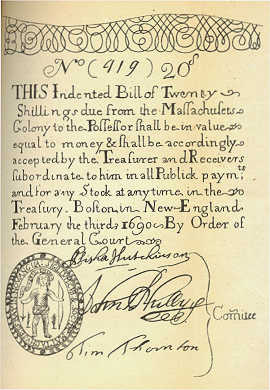 |
| A bill from 1690 in Massachusetts. This bill was from one of the first emissions of paper money by the General Court. From: http://www.celebrateboston.com/ |
Opponents of paper money had a strict understanding of the value of money--the only money worthy of the name was specie--i.e., gold and silver. They argued that paper money allowed New England consumers of British goods to get into too much debt. They did not believe that an imbalance of trade between the colonies and Britain was economically healthy (throughout the colonial period, colonists' imports surpassed their natural resource exports in value). Anti-paper money figures tended to be wealthy merchants involved in the Atlantic trade. Therefore, they had plenty of access to specie and did not have to worry about the liquidity of their assets.
Massachusetts was compelled to finance a series of wars in the 1690s and early 1700s through issuing paper money. The way this worked was that the colonial government would print the money, then use it to pay soldiers and war suppliers. These people could in turn purchase goods from others with the paper. Its value was upheld by the fact that the colonial government made taxes payable with the paper money. However, if the war became expensive, it was very easy to print too much money--more money than could be taxed back into the government in any reasonable period of time. At this point, paper money would begin to depreciate--it was a fear that people would try to pay their creditors (who were often merchants) using depreciated paper money that added another argument against paper. But people like John Wise, an Ipswich minister, believed that, despite its potential failings, paper money had an overall positive effect on the New England economy. Kind of like a good wife... despite some downsides, you make the best of her. (I hope I don't get in big trouble with you-know-who for this!)
Monday, April 29, 2013
A Sow's Arse
"An anonymous [Philadelphia] pamphleteer, styling himself 'Roger Plowman' in a 'letter' to 'Mr. Robert Rich,' began to dig deeper into the economic motives of those who opposed paper money: 'the principal Reason why you are angry with Paper-money, is because People who are in your Debt can raise money to pay you, without surrendering up their Lands for one half of what they are worth.' [James] Logan [a leading Philadelphia conservative politician of the 1720s] had argued that without the rich, the poor would always be poor. 'Roger Plowman' reversed the proposition, suggesting that because of the rich, the poor would remain poor. 'It is an old Saying with us,' he wrote, 'that we must never grease the fat Sow in the Arse, and starve the Pigs.'" (94) --Gary B. Nash, The Urban Crucible: The Northern Seaports and the Origins of the American Revolution
In the 18th century before the Revolution, colonies would occasionally circulate fixed amounts of paper money. One of several ways that this could be done would be the exchange of paper money with landowners as a loan with the land serving as collateral. Having paper money made it easier for taxpayers to pay their taxes, debtors to pay their creditors, and generally exchange goods with one another. If you had only large value assets, then paper money could enable you to make small scale transactions for your necessities. But paper money was always accompanied by a fear among wealthy creditors of it becoming depreciated--and being forced to accept depreciated money from their debtors.
On the other hand, if a creditor sued a debtor for collection when paper money was scarce, a debtor's property would be auctioned off or transferred to the creditor at depreciated values. The reason for this was that an auction of debtor assets occurring in a situation of cash scarcity meant that there would be few bidders; and fewer bidders meant that the final bid would be for a lower amount. Consequently, it required more valuable assets to pay off a creditor when money was scarce. This explains Roger Plowman's assertion that without paper money, people would have to surrender "up their lands for one half of what they are worth." A wealthy creditor could get lots of money or valuable assets at bargain basement prices in a money-starved economy. Roger Plowman, of course, knew these facts well. He or his acquaintances must have been the pigs who were starved in order to grease the fat sow's (creditor) arse!
 |
| "An Unpromising Drawing To Put a Joke To." From: New York Public Library Picture Collection Online |
In the 18th century before the Revolution, colonies would occasionally circulate fixed amounts of paper money. One of several ways that this could be done would be the exchange of paper money with landowners as a loan with the land serving as collateral. Having paper money made it easier for taxpayers to pay their taxes, debtors to pay their creditors, and generally exchange goods with one another. If you had only large value assets, then paper money could enable you to make small scale transactions for your necessities. But paper money was always accompanied by a fear among wealthy creditors of it becoming depreciated--and being forced to accept depreciated money from their debtors.
On the other hand, if a creditor sued a debtor for collection when paper money was scarce, a debtor's property would be auctioned off or transferred to the creditor at depreciated values. The reason for this was that an auction of debtor assets occurring in a situation of cash scarcity meant that there would be few bidders; and fewer bidders meant that the final bid would be for a lower amount. Consequently, it required more valuable assets to pay off a creditor when money was scarce. This explains Roger Plowman's assertion that without paper money, people would have to surrender "up their lands for one half of what they are worth." A wealthy creditor could get lots of money or valuable assets at bargain basement prices in a money-starved economy. Roger Plowman, of course, knew these facts well. He or his acquaintances must have been the pigs who were starved in order to grease the fat sow's (creditor) arse!
Sunday, April 28, 2013
A Well-Dressed Cow
"Most [Boston] pamphleteers of the 1730s and early 1740s beamed their arguments at the middle and upper elements of society, focusing on the sufferings of those with fixed incomes, such as teachers, clergymen, and widows. These people were undoubtedly pinched by the adverse wage-price trends, and one of their kind may have been the wit who sent a cow draped in silks and laces meandering through the streets in 1735 to dramatize the high cost of meat." (72) --Gary B. Nash, The Urban Crucible: The Northern Seaports and the Origins of the American Revolution
In the 1730s and 1740s, Boston continued to experience price inflation. Massachusetts's participation in Queen Anne's War in the first decade of the century caused severe economic disruption. The colony went into debt in paying for the war. To finance the debt, Massachusetts issued paper money. The colonial theory of paper money dictated that if paper money was issued, then it needed to be collected back through taxes in a timely manner. The timeliness of collection would preserve the value of the money. But if collection were delayed, the money would begin to lose value. Taxpayers had to have confidence that if they accepted paper money as payment for goods they were selling or labor they were performing, they could turn around and use it to pay their taxes. But Massachusetts dug itself into too deep of a debt hole during the war. We all know how taxpayers respond when asked to pay high taxes in a short period of time. Colonial officials knew this too, so they spread out the tax collection over a number of years; but this extension devalued the paper money and added extra interest costs for financing the debt.
Unfortunately, prices were inflated at a faster rate than laborers' wages. While Boston's population continued to grow, the agricultural production of its hinterland was beginning to reach capacity due to its poor soil. This had a depressing effect on the city's economy. There was no shortage of labor as population rose and production stagnated--thus the low laborer wages. Price inflation therefore impacted the laboring classes more severely than well-to-do people. An increasingly larger percentage of their income was taken up in purchasing basic necessities, such as meat. The rising price of meat unfortunately must have made it a luxury item for laboring class people. If so, why not protest this unwelcome change by dressing the meat with other luxury items such as silk and lace?
 |
| "Cow" From: New York Public Library Picture Collection Online |
In the 1730s and 1740s, Boston continued to experience price inflation. Massachusetts's participation in Queen Anne's War in the first decade of the century caused severe economic disruption. The colony went into debt in paying for the war. To finance the debt, Massachusetts issued paper money. The colonial theory of paper money dictated that if paper money was issued, then it needed to be collected back through taxes in a timely manner. The timeliness of collection would preserve the value of the money. But if collection were delayed, the money would begin to lose value. Taxpayers had to have confidence that if they accepted paper money as payment for goods they were selling or labor they were performing, they could turn around and use it to pay their taxes. But Massachusetts dug itself into too deep of a debt hole during the war. We all know how taxpayers respond when asked to pay high taxes in a short period of time. Colonial officials knew this too, so they spread out the tax collection over a number of years; but this extension devalued the paper money and added extra interest costs for financing the debt.
Unfortunately, prices were inflated at a faster rate than laborers' wages. While Boston's population continued to grow, the agricultural production of its hinterland was beginning to reach capacity due to its poor soil. This had a depressing effect on the city's economy. There was no shortage of labor as population rose and production stagnated--thus the low laborer wages. Price inflation therefore impacted the laboring classes more severely than well-to-do people. An increasingly larger percentage of their income was taken up in purchasing basic necessities, such as meat. The rising price of meat unfortunately must have made it a luxury item for laboring class people. If so, why not protest this unwelcome change by dressing the meat with other luxury items such as silk and lace?
Friday, April 5, 2013
Paper Money, or Jesus Christ
"In what was possibly the most audacious attempt to use the Bible to justify relief legislation, an essay appearing in Massachusetts in September 1786 compared paper money to Jesus Christ. The author permitted paper currency to speak in its own defense, reminding Americans that it had sacrificed its life for them. Even as its own value melted away, the currency recalled, it had funded the war that secured American independence. Paper money then prophesied that, like Jesus Christ, it would soon return. 'I died for their deliverance from foreign foes,' it declared, 'and will rise again to deliver them from their domestick ones." --Woody Holton in UNRULY AMERICANS AND THE ORIGINS OF THE CONSTITUTION
A little context: following the end of the Revolutionary War in the 1780s, Americans were forced to pay high taxes so that Congress and the states could pay interest to government bondholders. These bonds were issued by the federal and state governments during the war when public funds were running short. For example, bonds were often issued as payment to Continental Army soldiers. Because of the financial hardship experienced by many Americans during the recession of the 1780s, many of the bonds found their way into the hands of wealthy investors. Unfortunately, many state taxes had to be paid in specie (gold or silver), which was scarce.
There was also a shortage of paper money. Many Americans advocated for the printing of paper money by state assemblies so that taxes would be easier to pay. But legislators were skeptical of this solution. The problem was that paper money had a poor recent history of depreciating in value very quickly. The Continental Congress had issued so much paper money during the war that by 1780, it was almost worthless. It must be conceded that, even though Congress was almost broke by the end of the war, issuing paper money played a major role in enabling them to pay for it. In a way, Congress issuing paper money (i.e. Continentals) was crucial to winning the war.
Paper money's poor history of value stability made wealthy bondholders skeptical of taxes being paid with it--they didn't want worthless paper money for their bond interest income--they wanted stable-valued gold or silver. But paper money would have made it much easier for Americans to pay the high taxes. Property, especially land, was extremely illiquid. If you were a farmer who had to pay a tax of 10% of your property value, but were not able to pull together this sum by selling livestock, produce, or other assets, then you might have to sell your land (often at a fraction of its real value because no one else had money either) just to pay the tax. Paper money made exchanges of goods, such as livestock or produce, much easier. Therefore, raising a tax sum was more easily done with paper money in circulation. Holton describes how farmers and other "ordinary" Americans pressed their state assemblies to issue paper money. Thus, in reading Holton's book, you come to the above bizarre comparison of paper money to Jesus Christ!
 |
| UNRULY AMERICANS AND THE ORIGINS OF THE CONSTITUTION by Woody Holton |
A little context: following the end of the Revolutionary War in the 1780s, Americans were forced to pay high taxes so that Congress and the states could pay interest to government bondholders. These bonds were issued by the federal and state governments during the war when public funds were running short. For example, bonds were often issued as payment to Continental Army soldiers. Because of the financial hardship experienced by many Americans during the recession of the 1780s, many of the bonds found their way into the hands of wealthy investors. Unfortunately, many state taxes had to be paid in specie (gold or silver), which was scarce.
There was also a shortage of paper money. Many Americans advocated for the printing of paper money by state assemblies so that taxes would be easier to pay. But legislators were skeptical of this solution. The problem was that paper money had a poor recent history of depreciating in value very quickly. The Continental Congress had issued so much paper money during the war that by 1780, it was almost worthless. It must be conceded that, even though Congress was almost broke by the end of the war, issuing paper money played a major role in enabling them to pay for it. In a way, Congress issuing paper money (i.e. Continentals) was crucial to winning the war.
Paper money's poor history of value stability made wealthy bondholders skeptical of taxes being paid with it--they didn't want worthless paper money for their bond interest income--they wanted stable-valued gold or silver. But paper money would have made it much easier for Americans to pay the high taxes. Property, especially land, was extremely illiquid. If you were a farmer who had to pay a tax of 10% of your property value, but were not able to pull together this sum by selling livestock, produce, or other assets, then you might have to sell your land (often at a fraction of its real value because no one else had money either) just to pay the tax. Paper money made exchanges of goods, such as livestock or produce, much easier. Therefore, raising a tax sum was more easily done with paper money in circulation. Holton describes how farmers and other "ordinary" Americans pressed their state assemblies to issue paper money. Thus, in reading Holton's book, you come to the above bizarre comparison of paper money to Jesus Christ!
Subscribe to:
Posts (Atom)