Showing posts with label United States history. Show all posts

Saturday, July 18, 2015

Railroad Pie

In the mid-19th century, most trains would stop for 20-30 minutes at mealtimes in whatever city or town they happened to be passing through. In the cities, competition between multiple eating establishments seems to have raised the quality of the food. However, the majority of these meal stops were made in places where hungry passengers had few options to choose from and a short time to do it. With no competition, one can only imagine the poor quality of food offered to captive passengers. Food historian James D. Porterfield describes the offered repasts:
James D. Porterfield, Dining by Rail:
The History and Recipes of America's
Golden Age of Railroad Cuisine

"These early eating stops were nearly always described as terrible. The bitter black coffee may have been brewed only once a week. The ham could be dry, salty, and tough. Hard-cooked eggs were stored for an indeterminate period of time in limed water to keep them from discoloring. Fried eggs may have been cooked in rancid grease and certainly were served on stale bread. Here also one found leaden biscuits--their nickname, 'sinkers', giving a clue as to their quality--and something which earned the euphemism 'railroad pie'. The recipe was thought to be to take two crusts of cardboard and fill them with thickened glue." (58) --John P. Hankey, "Riding on the Rail,"  Rails Across America: A History of Railroads in North America, quoting James D. Porterfield's Dining by Rail: The History and the Recipes of America's Golden Age of Railroad Cuisine

Saturday, April 27, 2013

Election Trickery in New York

"On election day [late 1690s], orders were sent to the captains of English ships in the harbor to send their sailors to the polling place so that the Leislerians, who were heavily represented in the laboring class, would believe an impressment was imminent. This ruse proved successful, sending the Leislerian candidates down in defeat." (55) --Gary B. Nash, The Urban Crucible: The Northern Seaports and the Origins of the American Revolution
"New Amsterdam, now called New York"
From: New York Public Library Picture Collection Online


New York politics in the 1690s was dominated by two political factions: the Leislerians and the anti-Leislerians. Although the two did not precisely divide along ethnic and class lines, Leislerians were highly representative of Dutch and laboring class New Yorkers while the anti-Leislerians were generally representative of socially and economically elite English and Dutch New Yorkers. The two parties were formed in reaction to Jacob Leisler, the self-proclaimed governor of New York from 1689 to 1691. Leisler had taken advantage of the change of royal power during the Glorious Revolution in England to seize political control of the New York colony. He remained in this position until 1691 when England sent a new royally appointed governor. Leisler did not relinquish power voluntarily; he was arrested, tried and found guilty of treason by an all-English jury, and executed. His Dutch and laboring class supporters remained politically active after Leisler's death.

The other background detail you need to know in order to understand this quote has to do with English impressments. In the colonial period, when the British navy was in need of new sailors during wartime, impressment gangs would come ashore in American cities and force able-bodied men into naval service. Therefore, able-bodied men had an incentive to steer clear of impressment gangs. In this case, the anti-Leislerians were able to discourage laboring class voters from being in the streets and voting simply by creating the appearance of an impressment. This was quite a trick!

Sunday, April 21, 2013

Do you prefer bucks or dollars?

"The middle ground, it is true, had by the late eighteenth century operated to create a common system of exchange and even unit systems of values. Traders in the southern pays d'en haut [roughly, the Great Lakes region] had, for instance, instituted the buck--the hide of a large male white-tailed deer--as the standard unit in whose terms they calculated both the value of other furs and of European manufactures. The buck, in turn, became equated with an American silver dollar." (484) --Richard White, The Middle Ground: Indians, Empires, and Republics in the Great Lakes Region, 1650-1815
White-tailed Deer
(From U.S. Fish & Wildlife Service)


A world of explanation: White defines the "middle ground" as the "place in between: in between cultures, peoples, and in between empires and the nonstate world of villages." In other words, the middle ground is not necessarily a geographic place. It was the "place" at which two completely different cultures, Indians and Europeans, could meet, understand each other, and establish trading relationships. As a general idea, this idea of a middle ground could apply to many different instances in history. White has chosen to apply the concept to the Great Lakes Region from the 17th to 19th centuries.

So a buck was a originally a real buckskin, not a paper dollar! Actually, almost anything can serve as money. Buckskins, paper, silver, gold, beads, tobacco, have all been used as money in the past. The major requirement is that when you receive money in exchange for your goods or services, you have confidence that you can turn around and use the money to purchase something you want to buy--in other words, that that person will accept your money.

Thursday, April 18, 2013

Slaveholders for Natural Rights

"Consider, for example, the conduct of Richard Henry Lee, the Virginia leader who moved the formal congressional resolution declaring American independence in June 1776. There is no evidence that Virginians had thought it ridiculous for Lee to conduct a public parade in Virginia against the Stamp Act's 'chains of slavery' while literally using his slaves to hold his protest banners." (38)

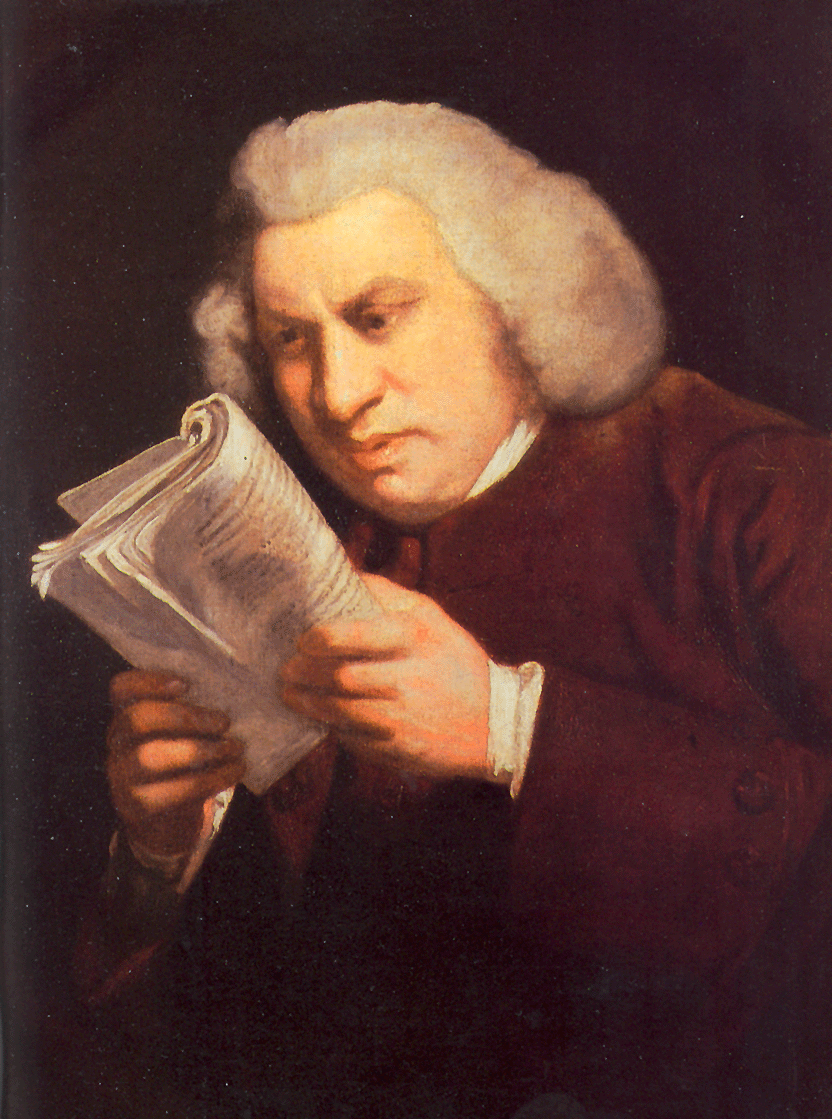
"Anyone familiar with Samuel Johnson's famous gibe--'How is it that we hear the loudest yelps for liberty from the drivers of negroes?'--will appreciate that many Englishmen and contemporary Americans (Northern and Southern) thought that there was tension between American revolutionary principles and the institution of slavery." (42) --both quotes from George William Van Cleve's A SLAVEHOLDERS' UNION
Samuel Johnson
From: Wikipedia

Van Cleve argues that, despite the ideological advances made against the institution of slavery during the Revolutionary War, slavery was ultimately more strongly entrenched following that war than it was before the war. This was due to the political unity of the slave states around a single issue and the substantial (50%) portion of the new nation's overall wealth that was located in the South. The hypocrisy of Americans around slavery and individual liberty was the main reason that Charles Dickens so greatly disliked the United States. By the time he got to the U.S. in 1843, the nation billing itself as a beacon to the world of equality and liberty had been holding slaves for 60 years.