Showing posts with label ancient philosophy. Show all posts

Monday, October 28, 2013

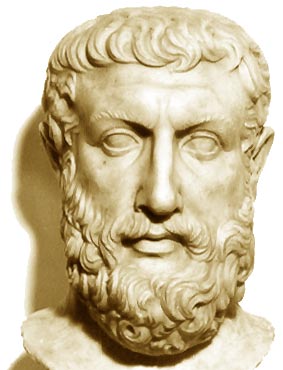
The History of Metaphysics as a Footnote to Parmenides

Parmenides (ca. 515-450 B.C.E.)
(From: Wikipedia)
"Back we go to Parmenides and his argument to the effect that we can never know the world. What, then, can we know? And what can we do with philosophy if it brings us to that abrupt and final conclusion? One possibility: spend the next two thousand years attacking the premises, criticizing and refining the logic, clarifying and extrapolating the terms 'existence' and 'is,' reinterpreting the conclusion, reaffirming the conclusion, reconstructing the argument, translating the argument into theology, converting the theology into ontology, redefining ontology and reducing it to semantics, redefining and returning it to the language of common sense once again, then challenging or ridiculing common sense and turning it back into paradox, further refining the logic, generating new and even more puzzling paradoxes..." (39) --Robert C. Solomon and Kathleen M. Higgins, A Short History of Philosophy

Madness, no?

Tuesday, October 22, 2013

Philosophy on the Can

An ideal place to philosophize? Some might say so.
(From: Wikipedia)
"Long before the sixth century B.C.E., there were already flourishing civilizations in the eastern Mediterranean, the Middle East, Asia, and Africa. The Greeks (or Hellenes) were a group of nomadic Indo-Europeans who came down from the north and replaced a people already settled by the Aegean Sea. (This displaced people moved and founded a great civilization on the island of Crete. We've completely lost their language, but it is hard to believe that they didn't have a profound and complex philosophy. After all, they even had indoor plumbing.) (7) --Robert C. Solomon and Kathleen M. Higgins, A Short History of Philosophy

The question here is whether the fact of indoor plumbing serves as: 1) an indication of this civilization's engineering and intellectual prowess, or 2) as a facilitator for reaching higher levels of philosophical abstraction. In other words, does the availability of an indoor toilet as an ideal location to philosophize lead one to the conclusion that this civilization's philosophical complexity was probably high?