Showing posts with label metaphysics. Show all posts

Friday, November 15, 2013

It's All In Your Head

George Berkeley (From: Wikipedia)
"[George] Berkeley was quite happy to suppose that there was no substantial world apart from the world in our minds. The world was indeed composed of ideas--a position subsequently known as idealism... If there were no 'external' world to serve as cause of our sensations, where would our sensations and our ideas about the world come from? It is God who must provide them, Berkeley argues. 'To be is to be perceived,' he insists, but everything that exists must therefore be perceived, all the time, by God. (It was regarding Berkeley's philosophy that some wit formulated the old gambit, 'If a tree falls in the forest...') Perhaps what is most remarkable is the fact that Berkeley's philosophy, which denies the material existence of the world, held onto the Lockean claim to be merely a matter of 'common sense.' (How often, in philosophy, would the appeal to common sense end up in nonsense.) The English Doctor Johnson thought that Berkeley's idealism was hardly common sense at all, and kicking a stone he commented to a friend, 'Thus I refute him.'" (196) --Robert C. Solomon and Kathleen M. Higgins, A Short History of Philosophy

Thursday, November 7, 2013

A Heated Debate, But Who Cares?
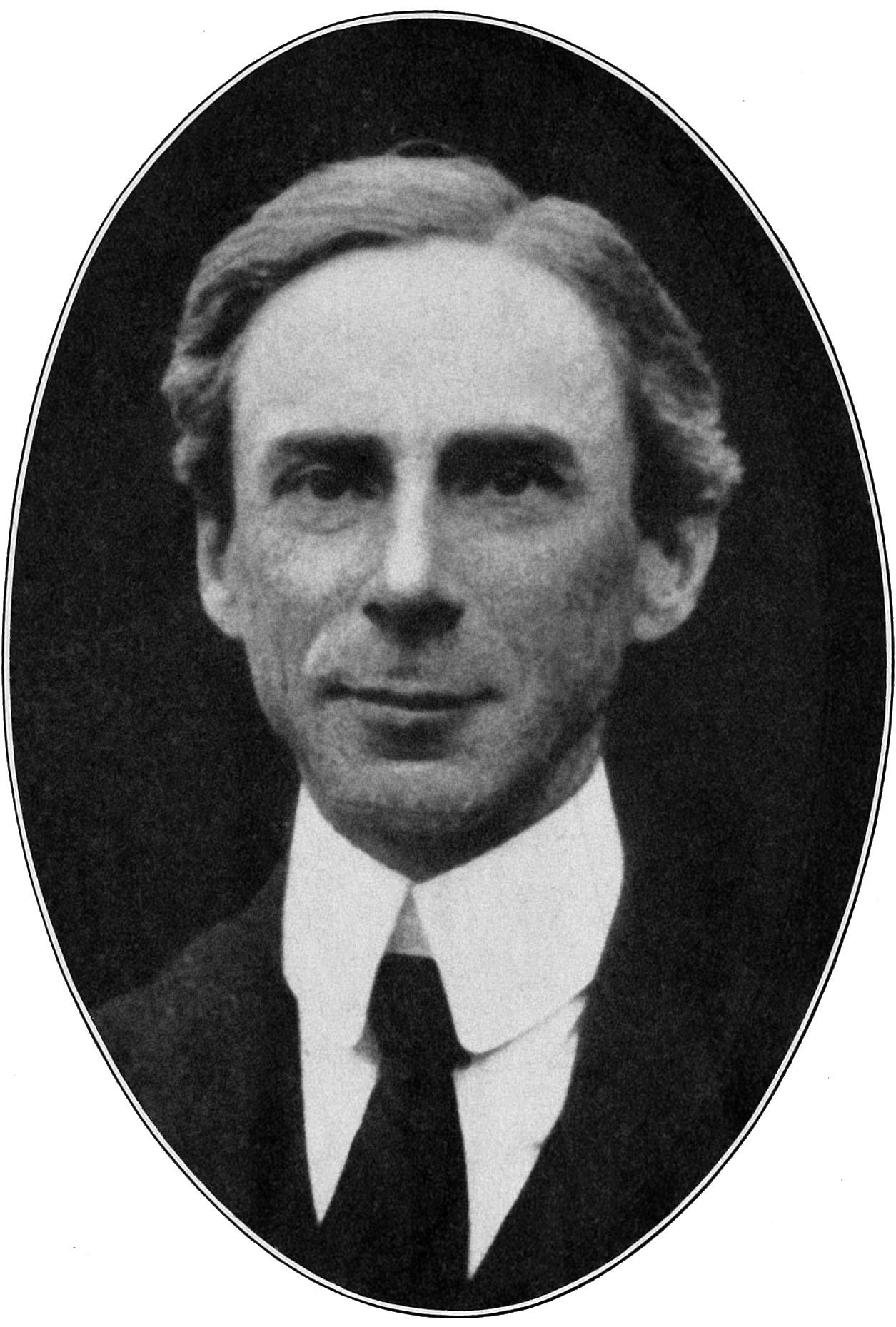
Bertrand Russell
(From: Wikipedia)
"What if realism were true, but everyone were a nominalist, or vice versa--would there be any difference whatever in the world?" (149) --Bertrand Russell quoted in Robert C. Solomon and Kathleen M. Higgins, A Short History of Philosophy

A little background here: Realism is a metaphysical theory that dates back to Plato. It holds that for all the particular things or attributes in the world with the same appellation (e.g., triangles, white-colored things), there is a corresponding Form or universal that exists in a higher, non-material reality. All of the particular examples of that thing or attribute in the material world exist by participation in the Formal or universal thing. The Form is the perfect ideal by which all instances of it are measured.

Nominalists maintain that there are no Forms or universals existing in a higher reality or anywhere at all. Nominalism dates to the medieval philosopher Peter Abelard, but has similarities with Aristotle's ideas on this matter as well. All that exist are particular, material things and their attributes. For example, there is no Form of a tree through which all trees acquire their essential existence. All that exists are particular trees, despite the fact that we have the same appellation (viz., "tree") for all of them.

This is a highly simplified summary of a fierce debate that has raged for well over 2000 years. But Russell has a point. Is it a major concern for most people how it is that we are capable of using the same adjective "white" to describe many different instances of things with that color? I think probably not.

Monday, October 28, 2013

The History of Metaphysics as a Footnote to Parmenides
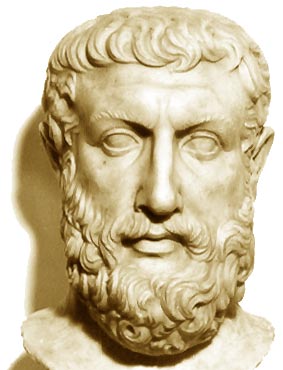
Parmenides (ca. 515-450 B.C.E.)
(From: Wikipedia)
"Back we go to Parmenides and his argument to the effect that we can never know the world. What, then, can we know? And what can we do with philosophy if it brings us to that abrupt and final conclusion? One possibility: spend the next two thousand years attacking the premises, criticizing and refining the logic, clarifying and extrapolating the terms 'existence' and 'is,' reinterpreting the conclusion, reaffirming the conclusion, reconstructing the argument, translating the argument into theology, converting the theology into ontology, redefining ontology and reducing it to semantics, redefining and returning it to the language of common sense once again, then challenging or ridiculing common sense and turning it back into paradox, further refining the logic, generating new and even more puzzling paradoxes..." (39) --Robert C. Solomon and Kathleen M. Higgins, A Short History of Philosophy

Madness, no?