Monday, August 11, 2014

Football and Bull Fights

"It has been said, not inaptly, that the relation of football to physical culture is much the same as that of the bull-fight to agriculture." (160) --Thorstein Veblen, The Theory of the Leisure Class (1994 Dover edition)

Veblen was not much of a football fan, was he? He wrote this in 1899. If you haven't read any Victorian texts recently, "physical culture" was the term then used for exercise and maintaining good physical fitness. Veblen's larger point is that football accentuates archaic human traits of predation and barbarism that are little economic use to a society. His ideas were part of the popular late 19th century ideology of social evolution. (You are probably more familiar with Herbert Spencer as social evolution's main advocate.) Veblen thought the evolution of the human species is driven by the natural selection of traits that enable humanity to progressively produce more wealth. For Veblen, it all comes down to whether certain human traits are useful in an economic sense. Apparently, football does not make the cut!

The Theory of the Leisure Class is a classic of economics and sociology. I would recommend it for its unique descriptions and explanations of Victorian upper class society--which, by the way, can be largely adapted to Americans of all classes today. His observations of the upper class's "conspicuous consumption" help one to understand why contemporary Americans (and probably all of Western society) are obsessed with consuming goods--cars, clothing, houses, etc--in order to remain "respectable" to their neighbors. However, Veblen's book is awfully convoluted. The organization of his arguments within chapters is sometimes hard to distinguish. I think he could have written this book using half the number of pages--and been better off for it.    

Monday, August 4, 2014

Drinking Health to King Jesus

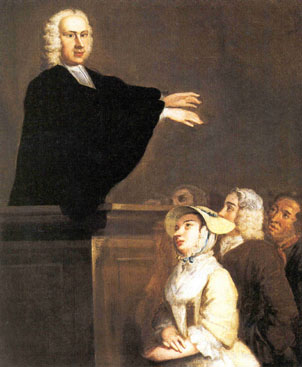
George Whitefield, whose preaching in 1740
began theGreat Awakening.
(From www.nndb.com)
The Great Awakening was "the boisterous and often fractious religious revivals that gripped New England following George Whitefield's celebrated preaching tour of 1740. Partisans of the Whitefieldian awakenings frequently referred to local events in places such as Newbury [Mass.] as a 'surprising,' 'extraordinary,' 'Glorious,' 'Marvelous,' and 'wonderfull' outpouring of God's Holy Spirit. More often, they simply called it 'the Work'...

"[In 1744], a Rowley [Mass.] layman named Richard Woodbury descended on Newbury, accompanied by Daniel Rogers and Nicholas Gilman. Together, they spent more than a month laboring to stir up fervent revival advocates in the town's two largest parishes. Woodbury claimed to possess the 'Power to bless and curse eternally whom he pleased.' He dared to drink 'healths to King Jesus' and vehemently condemned to hell anyone who questioned his charismatic authority. Exhibiting what one report called a 'strange Emotion,' Woodbury frequently fell into trances during which he would roll on the floor and rail against revival opposers, crying out that they had crucified Christ. Other reports suggested that he and his disciples bent to the ground and made crosses in the dust, before kissing and licking the earthen symbols." (65)  --Douglas L. Winiarski, "The Newbury Prayer Bill Hoax: Devotion and Deception in New England's Era of Great Awakenings," Massachusetts Historical Review, Vol. 14 (2012)

I should hasten to add in fairness that George Whitefield, John Wesley, and Jonathan Edwards, all closely associated with the First Great Awakening, would all have strongly disapproved of the sort of madness described above. There were both respectable and disreputable aspects of the First Great Awakening. Needless to say, Woodbury, Rogers, and Gilman represented the wilder side.

Sunday, August 3, 2014

Smallpox Under a Walnut Shell

"In 1716, while searching the [Royal Society's] Philosophical Transactions... [Cotton] Mather came across a report from Turkey describing a medical procedure that produced a mild case of smallpox and left the patient immune to the disease. The process involved removing infected tissue from one person and transferring it to a healthy individual. According to the report, a medical practitioner used a sharp needle to puncture a few pocks on a young person with a mild case of smallpox and extracted a small sample of the pus, which was pressed into a clean glass vessel that was covered and kept warm until it reached the home of the inoculee. There, the practitioner made one or two small wounds in the patient's arm with a needle or lancet, inserted a drop of the pus, and gently mixed it with the oozing blood. A walnut shell provided temporary protection for the wound. In due time, pocks appeared, but fewer than in natural smallpox, and the patient seldom suffered a high fever or other serious discomforts." (10) --Amalie M. Kass, "Boston's Historic Smallpox Epidemic," Massachusetts Historical Review, Vol. 14 (2012)
Dr. Zabdiel Boylston was one of the first physicians in Boston
to use smallpox inoculation. (From: Mass Moments)

I wonder how it was first discovered that the inoculation procedure described above protected people against a more severe case of smallpox. Who was the very first physician to conduct it--and what were they thinking?! Just as important, who was the first volunteer for the experiment?

Kass describes what 17th century Bostonians believed the causes of smallpox to be. First of all, it was a punishment from God for the sins of an individual or community. Second, it was thought to result from an imbalance in bodily fluids--a conclusion based on ancient Greeks' humoral theory. Kass explains, "According to humoral theory, good health required a balance of the four elements--blood, phlegm, yellow bile, and black bile--that constituted the bodily fluids. Disease indicated that one or more of the humors was either deficient or excessive due to internal or external factors." (4)

Bostonians were in some degree aware of smallpox's contagiousness. Kass describes how quarantine measures were taken and efforts made to clean up the city's streets at the first sign of smallpox. But does it not seem to be the height of insanity to transfer the bodily fluids from a person with a deadly disease to a healthy person! What was the reasoning here for the first physician to try this out?

The reasoning seemed to have been based on the observation that once a person had had smallpox, he/she was in most cases immune from it during subsequent epidemics. The idea must have been that if the pus could be taken from the sores of a person with a mild case of it and transferred to a healthy person, then the latter would hopefully be infected with only a mild case and later become immune. Seems reasonable in a way... but, with smallpox's contagiousness being common knowledge, I sure wouldn't want to be the first guinea pig for this experiment!

Sunday, July 27, 2014

A "Rain of Blood"

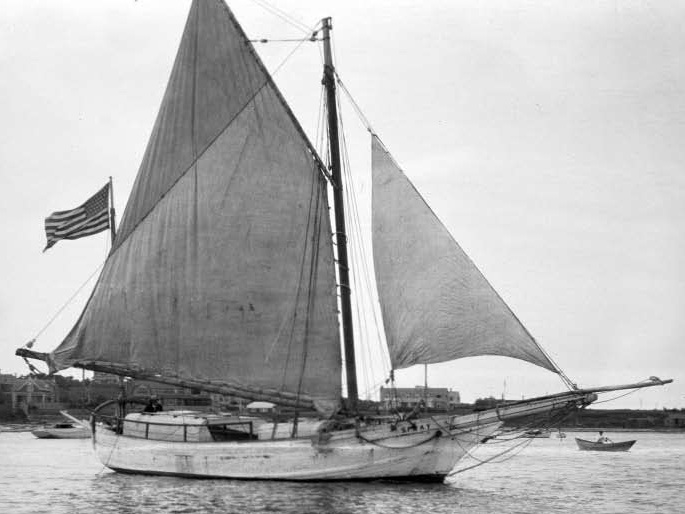
Captain Joshua Slocum was the first person to circumnavigate the globe in a sailboat. Spray. In 1900, he published a best-selling book about the trip, Sailing Alone Around the World. The book has become a classic of nonfiction sea adventure prose. In the passage below, Slocum describes a strange natural phenomenon that occurred during his stay in Melbourne, Australia.
The Spray (From: Wikipedia)
It took him three years, 1895-1898, to accomplish this feat. He sailed a 37-foot yawl that he built himself while in New Bedford, Massachusetts. He called it the

"I should mention that while I was at Melbourne there occurred one of those extraordinary storms sometimes called 'rain of blood,' the first of the kind in many years about Australia. The 'blood' came from a fine brick-dust matter afloat in the air from the deserts. A rain-storm setting in brought down this dust simply as mud; it fell in such quantities that a bucketful was collected from the sloop's [Spray] awnings, which were spread at the time. When the wind blew hard and I was obliged to furl awnings, her sails, unprotected on the booms, got mud-stained from clue to earing.
"Red dust storm at Belmore Bridge, Maitland, New South Wales, Australia"
(From: Wikimedia Commons)


The phenomena of dust-storms, well understood by scientists, are not uncommon on the coast of Africa. Reaching some distance out over the sea, they frequently cover the track of ships, as in the case of the one through which the Spray passed in the earlier part of her voyage. Sailors no longer regard them with superstitious fear, but our credulous brothers on the land cry out 'Rain of blood!' at the first splash of the awful mud." (p. 177, Dover Edition, 1956) --Joshua Slocum, Sailing Alone Around the World


Tuesday, July 15, 2014

Chasing a Moonshiner "Far and Squar"

A policeman with wrecked automobile and
confiscated moonshiner, 1922. Pairing this picture with
the story here is not quite accurate. The story here about
"Byron" probably happened in either the 1950s or 1960s.
(From: Wikipedia) 
"'The facets of human nature are never in greater play.' These are Byron's words (though Byron is not his real name), which explain the fascination of his work to him and the common bond between the moonshiner, or blockader, and the revenuer. At their best, they respect each other as honorable men constantly testing each other over the years to determine whose skills are the sharper honed.

Once, for example, Byron was chasing a moonshiner's car through the mountains. He thought he was gaining ground when suddenly he missed a curve and spun into a ditch. The moonshiner could have made a clean getaway, but instead his car backed up as fast as he'd been moving forward.

'You hurt, captain?' asked the mountain man. He insisted on calling Byron captain, even though he'd only been a sergeant in the Marine Corps.

Then, however, he saw that Byron was unhurt and could back the car out of the ditch. 'How fur ahead of you was I?'

'Down to the turn, I think,' replied the revenue agent.

'Reckon it was a quarter mile more, captain.'

Byron knew that man was being truthful, according to the codes. If he or any other agent were to testify in court that a moonshiner on a chase was driving 120 miles per hour when he actually was doing only 90, that would not be playing 'far and squar.' An agent who lies is an unworthy competitor.

They resumed their positions and the pursuit went on. Byron failed to catch the man. The next time he came into Balsam Grove, he was asked with a smile, 'How's your driving, captain?'

And he was obliged to reply, 'Improving.'" (284)
--Michael Frome, Strangers in High Places: The Story of the Great Smoky Mountains

Sunday, July 13, 2014

Rogers, you're fired.

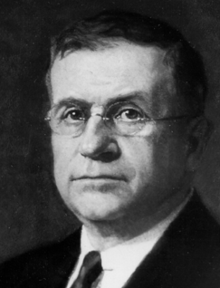
Harold L. Ickes was U.S. Secretary of the Interior from 1933 to 1946. 

Harold L. Ickes (From: Wikipedia)
"Ickes was a strong member of Franklin Roosevelt's cabinet. He felt that he could resist, or even insult, members of the Senate... because he had the President's backing. He worked hard at conservation and left noteworthy accomplishments... However, he suffered from shortcomings in his own personality--which he recognized. He was temperamental, unpredictable, stubborn, given to tantrums, a many-sided man, difficult to understand, who could look out his office window and shudder with sentiment at the sight of a tree being removed from Rawlins Park, then turn around and blaspheme some well-intentioned and perfectly competent subordinate...

...a [national park] superintendent was summoned to his office. The man stood before his desk. The Secretary did not look up but continued working through his papers. 'Rogers,' said Ickes after a time, without ever greeting the man or even looking at him, 'you're fired.' The man's jaw dropped; he was wordless. Ickes continued with his desk work. The superintendent withdrew from the Secretary's office to national park headquarters, where he reported the grisly episode to Arthur E. Demaray, the Associate Director, whose special facility was handling Ickes. 'Don't worry,' Demaray directed. 'Go back to your park. We'll take care of it.' Not another word was heard from Ickes." (228) --Michael Frome, Strangers in High Places: The Story of the Great Smoky Mountains 

Wednesday, July 9, 2014

Exterminating Indians in the Christian Way

"Yonaguska, or Ya'nu-gun'ski, Drowning Bear, is a key figure in the Smoky Mountains story. Others in Georgia played much larger roles in the history of the [Cherokee] Nation, but none meant more to the isolated mountain Cherokee. He is described as a handsome, tall man of six foot three, a powerful orator, and a prophet... he swore off whiskey and led his people in taking the pledge. Thus, during Yonaguska's lifetime the Smoky Mountain Cherokee were free of the historic cursed plague inflicted upon them from without. Since early days, traders had found it profitable to haul in liquor, legally or otherwise. Sometimes treaty commissioners weakened Indian opposition with doses of firewater. Its dangers were of grave concern to Cherokee leaders, who enacted strict laws regulating the sale of whiskey, which the whites persistently and successfully evaded...

Drowning Bear's principal influence, however, was in holding his people to the mountains and to the old religion of the mountains. He did not succomb to Christian missionaries, but after listening to one or two chapters of the Bible, remarked, 'It seems to be a good book--strange that the white people are not better, after having had it so long." (86) --Michael Frome, Strangers in High Places: The Story of the Great Smoky Mountains

Drowning Bear died in 1839 at the age of sixty. His lifetime spanned a period of time in which the federal government made a series of forced treaties with the Cherokees that gradually took away their ancestral lands, culminating with the Trail of Tears in October 1838. 14,000 Cherokees were rounded up by the U.S. Army into concentration camps, then forced at gunpoint to march to Oklahoma. Several thousand died from starvation and weather exposure along the way. However, a small number of Cherokees managed to avoid the Trail of Tears by hiding out in the mountains. They are the ancestors of those Cherokees who today live in North Carolina. Drowning Bear was the leader of these fugitives.