Showing posts with label 20th Century. Show all posts

Saturday, March 5, 2016

An Alcoholic Cod

"During Prohibition, fishermen, like everyone else, had to find ways to supplement their meager income. One way for a lobsterman to do so was to turn to a bit of low-level rum-running. The lobsterman would place orders in notes in his traps and then retrieve the traps a day or two later. In them he found, in place of the notes, peculiar lobsters... in the shape of bottles of booze...
Atlantic Cod (From: Wikipedia)

In July 1929 three Isleboro [Maine] fisherman, in outer Penobscot Bay, pulled in a seventy-pound cod. When dressing it, they found a sealed full-size bottle of bootleg whiskey in its gut. Cod are notorious for swallowing anything within reach--and this bottle, no doubt, was pitched overboard by a rumrunner being pursued, perhaps even a rum-running lobsterman." (230) --Matthew P. Mayo, Bootleggers, Lobstermen & Lumberjacks: Fifty of the Grittiest Moments in the History of Hardscrabble New England 

Sunday, July 5, 2015

Johnny Appleseed(s) of Pot

"By [the mid-1970s], the American backwoods were filling with self-styled Johnny Appleseeds sowing cannabis seeds far and wide as they dreamed of a new Utopia of the Stoned. (The phrase 'Johnny Appleseed of Pot' recently produced nearly ten thousand hits on Google.)" (268) --Howard Means, Johnny Appleseed: The Man, The Myth, The American Story

Johnny Appleseed (From: Wikipedia)
Means published this book in 2011, so his Google search is somewhat outdated. I searched for the phrase "Johnny Appleseed of Pot" and received just 214 results--all highly entertaining by the way. If you search without the phrase quotes, then you get 129,000 results; but this is misleading because there are a number of websites that talk about the pot, as in a metal pan, that Johnny Appleseed wore on his head--in other words, nothing to do with the other kind of "pot."

I don't know about the 1970s, but as recently as 2005, there was a "Johnny Appleseed of Pot" in Benzie County, Michigan. This specialty nurseryman would search for ideal places to plant marijuana, no matter who the landowner was, sow his seeds, then check back later to tend them. Exactly the pattern used by the real Johnny Appleseed!

Friday, February 27, 2015

Not a "Pastime for Curious Women"

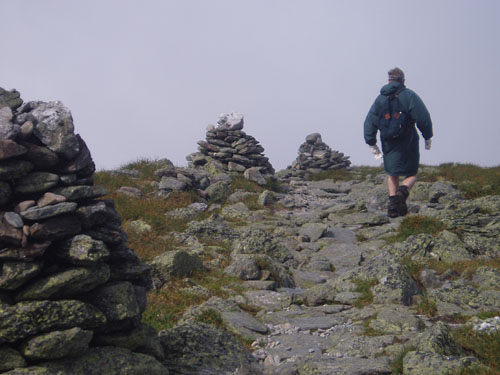
Edmands' smooth rocks of the Gulfside Trail.
(From: www.legacysailing.com)
In August 2014, I hiked the Presidential Range of the White Mountains. I noticed an interesting phenomenon a mile or two west of Madison Spring Hut on the Gulfside Trail. The rocks on the trail seemed perfectly placed to form a flat surface, as if forming an alpine highway. Compared to most of the other alpine trails on the trip, this piece of trail was easy to walk! It was like an alpine sidewalk. I asked a croo member at the hut what the explanation for this was. Who would have spent the immense amount of time and labor to place all those rocks just so?! I was told that J. Rayner Edmands, a famous trail builder of the early 20th century had laid out the Gulfside Trail. 

In the latest issue of the Appalachian Mountain Club's journal, Appalachia, I encountered more information about Edmands and his beautiful trails. Edmands had a trail-building rival in the Whites: Warren Hart, the Appalachian Mountain Club's Councillor of Trails. From 1909 to 1911, Hart blazed most of the trails now existent in the Great Gulf, a five thousand acre wilderness area enclosed by Mounts Washington, Clay, Jefferson, Adams, and Madison. Hart and Edmands had widely divergent trail building philosophies. For entertainment's sake, I'll let Hart describe these philosophies. He wrote a newspaper article in a 1909 issue of the Boston Evening Transcript.

Warren Hart (top) on the Six Husbands Trail
in the Great Gulf.
(From: whitemountainsojourn.blogspot.com)
"Unlike most of the paths in the White Mountains, these [Great Gulf] trails have not been cut to avoid obstacles, or to smooth them away as much as possible, they were not designed for the pastime of curious women; and they have not been made like to the superfluous boulevards of piled stone work that a perverted energy has built here and there upon the mountains..." (Appalachia, Winter/Spring 2015, 94-95)

I guess Hart was not a fan of Edmands' work, eh?


Tuesday, July 15, 2014

Chasing a Moonshiner "Far and Squar"

A policeman with wrecked automobile and
confiscated moonshiner, 1922. Pairing this picture with
the story here is not quite accurate. The story here about
"Byron" probably happened in either the 1950s or 1960s.
(From: Wikipedia
"'The facets of human nature are never in greater play.' These are Byron's words (though Byron is not his real name), which explain the fascination of his work to him and the common bond between the moonshiner, or blockader, and the revenuer. At their best, they respect each other as honorable men constantly testing each other over the years to determine whose skills are the sharper honed.

Once, for example, Byron was chasing a moonshiner's car through the mountains. He thought he was gaining ground when suddenly he missed a curve and spun into a ditch. The moonshiner could have made a clean getaway, but instead his car backed up as fast as he'd been moving forward.

'You hurt, captain?' asked the mountain man. He insisted on calling Byron captain, even though he'd only been a sergeant in the Marine Corps.

Then, however, he saw that Byron was unhurt and could back the car out of the ditch. 'How fur ahead of you was I?'

'Down to the turn, I think,' replied the revenue agent.

'Reckon it was a quarter mile more, captain.'

Byron knew that man was being truthful, according to the codes. If he or any other agent were to testify in court that a moonshiner on a chase was driving 120 miles per hour when he actually was doing only 90, that would not be playing 'far and squar.' An agent who lies is an unworthy competitor.

They resumed their positions and the pursuit went on. Byron failed to catch the man. The next time he came into Balsam Grove, he was asked with a smile, 'How's your driving, captain?'

And he was obliged to reply, 'Improving.'" (284)
--Michael Frome, Strangers in High Places: The Story of the Great Smoky Mountains

Sunday, July 13, 2014

Rogers, you're fired.

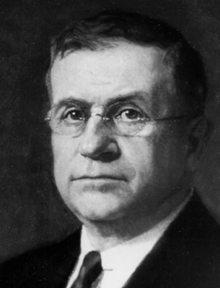
Harold L. Ickes was U.S. Secretary of the Interior from 1933 to 1946. 

Harold L. Ickes (From: Wikipedia)
"Ickes was a strong member of Franklin Roosevelt's cabinet. He felt that he could resist, or even insult, members of the Senate... because he had the President's backing. He worked hard at conservation and left noteworthy accomplishments... However, he suffered from shortcomings in his own personality--which he recognized. He was temperamental, unpredictable, stubborn, given to tantrums, a many-sided man, difficult to understand, who could look out his office window and shudder with sentiment at the sight of a tree being removed from Rawlins Park, then turn around and blaspheme some well-intentioned and perfectly competent subordinate...

...a [national park] superintendent was summoned to his office. The man stood before his desk. The Secretary did not look up but continued working through his papers. 'Rogers,' said Ickes after a time, without ever greeting the man or even looking at him, 'you're fired.' The man's jaw dropped; he was wordless. Ickes continued with his desk work. The superintendent withdrew from the Secretary's office to national park headquarters, where he reported the grisly episode to Arthur E. Demaray, the Associate Director, whose special facility was handling Ickes. 'Don't worry,' Demaray directed. 'Go back to your park. We'll take care of it.' Not another word was heard from Ickes." (228) --Michael Frome, Strangers in High Places: The Story of the Great Smoky Mountains 

Friday, June 13, 2014

Whiskey from a Truck Radiator

Moonshining in Kentucky (From: Wikimedia Commons)
"In the 1920s Prohibition brought boom times to moonshiners, and in some mountain areas almost every family was involved in one way or another with production or sale of whiskey. Many neglected farming altogether to concentrate on this profitable sideline. But repeal of Prohibition in 1933 again made liquor legally available, and to stay in business moonshiners not only had to lower their prices but also to lengthen their lines of distribution. As the price went down, so did quality. More important, moonshiners increasingly used old auto and truck radiators as their condensing equipment. The soldered joints of the radiators contaminate the whiskey with poisonous--even lethal--lead salts." (34) --Ronald M. Fisher, The Appalachian Trail

Friday, May 2, 2014

Shred, Shred, Shred

Citizens protesting and entering the Stasi building
in Berlin; the sign accuses the Stasi and 

SED of being Nazistic dictators. (From: Wikipedia)
"As the Berlin Wall fell in 1989-1990, the German Democratic Republic and the Federal Republic of Germany united with great speed and utter confusion. The records of the East German State Security Service (Ministerium fur Staatssicherheit, called the MfS or Stasi) were at first neglected by West German authorities preoccupied with the seemingly hopeless task of steering monumental changes that were beyond any governmental control. The Communist security apparatus continued to operate after the fall of the Wall, and party loyalists ran shredding machines around the clock in an effort to destroy incriminating evidence from forty years of intelligence-gathering activity. The shreds, which were saved, actually filled 15,587 mail sacks. In the power vacuum, East German dissidents and some more politically mainstream citizens invaded the Stasi headquarters in Berlin on 15 January 1990 to halt the destruction of records by Stasi functionaries. Certainly the dissidents wanted to preserve the evidence of the fallen regime's oppression for historical reasons. On a more personal level, they also wanted to know exactly who had been reporting the adverse information about them that had affected their jobs, personal freedom, and basic aspects of their lives... Archivists took on seemingly impossible tasks, such as the re-assembly of shredded documents. Some 400,000 pages have been pieced back together." (100-101) --Elena S. Danielson, "Privacy Rights and the Rights of Political Victims: Implications of the German Experience," in Menzi L. Behrnd-Klodt and Peter J. Wosh, eds., Privacy & Confidentiality Perspectives: Archivists & Archival Records

Wednesday, February 19, 2014

Archivist: "And in this box, we have radioactive uranium."

Chicago Pile One Scientists; Enrico Fermi is the
first man in the front row. Albert Wattenberg is
the third man in the front row. (From the Atomic Archive)
"University of Illinois physicist Albert Wattenberg didn't go to the Chicago branch of the National Archives last year looking for trouble. But when he could barely lift an 8-inch metal rod from a box containing artifacts used by nuclear physicist Enrico Fermi and his colleagues to build a nuclear pile under the University of Chicago football stadium, he new something was wrong. 'There's only one metal that heavy,' says Wattenberg, who was part of Fermi's team in the 1940s. 'It was obviously uranium.'

Wattenberg had literally put his fingers on a half-century of carelessness in preserving the beginnings of the nation's nuclear history. Thousands of artifacts contaminated by radionuclides during the testing and production of nuclear materials--laboratory notebooks, classified documents, components from experiments, and the like--were being stored along with nonradioactive material in files open to public inspection. Although the health hazards associated with these materials are small... the contamination is presenting the Department of Energy and the National Archives with a major cleanup problem." --Science, January 14, 1994, quoted on p121 in Gregory S. Hunter, Developing and Maintaining Practical Archives 

The archivist who processed that box must have been using a "More Product, Less Process" (MPLP) approach! "Hmmm... that's just a box of uranium pile artifacts. They certainly don't need item-level analysis. Next box, please!"

Friday, February 7, 2014

One-Fifth of a Five Sentence Five-Year Plan (Submitted Annually)

Seymour Cray (From: Wikipedia)
"For most routine transactions, records creation is managed through forms. Indeed, a branch of records management known as 'forms management' specializes in the creation of such documents. Forms routinize the types of information collected and the manner in which it is displayed... At higher levels of administration, the use of forms to control records creation is usually less successful... Some administrators, particularly those with reputations independent of their positions, go beyond merely creating records in very general forms or those that incidentally do not conform with 'standardized' procedures and use records creation as a way to flaunt their opposition to bureaucratic procedures. Seymour Cray, for years one of the world's most respected computer scientists and also an employee of Control Data Corporation, mocked the company's policy of creating one- and five-year plans by annually submitting a one-sentence plan, noting that this sentence was one-fifth of his five sentence five-year plan." (52) --Frank Boles, Selecting & Appraising Archives & Manuscripts

Seymour Cray was the creator of the first supercomputer. He was clearly a man to be respected by his peers at the Control Data Corporation. Just as clearly, he was a man who knew his true position in the world. One can clearly picture him, sitting at his desk, signing off on yet another one-sentence plan and forwarding it to his superiors at Control Data as he chuckles under his breath, "I wrote a one-sentence 0.2 year plan because I can write a one-sentence 0.2 year plan!" And we can envision Control Data's executives meeting to discuss what to do about that mischievous Seymour Cray. And the records managers cursing Seymour Cray because he just didn't conform to their perfect five-year plan categories. But what could they do? The man invented the supercomputer. I suppose they just had to let Seymour be Seymour.


Tuesday, February 4, 2014

Nixon:"Just destroy all the tapes."

Richard Nixon (From: Wikipedia)
"Richard Nixon had a one-line retort on Monday when asked about the lesson of Watergate: 'Just destroy all the tapes.' That's what he told the annual luncheon of The Associated Press when asked what his presidential successors could learn from his experience." (53) --Gregory S. Hunter, Developing and Maintaining Practical Archives, quoting Newsday, April 22, 1986

Thursday, October 3, 2013

A Bomb Dropped on Hiroshima... and a Sunny Bank Holiday

On August 6, 1945, an atomic bomb was dropped on Hiroshima, Japan by the United States. Here is the news reader's script from the first BBC report of the bomb:

"Monday,
August 6th, 1945
Six p.m.

HOME SERVICE:

Here is the News:

President Truman has announced a tremendous achievement by Allied scientists. They have produced the atomic bomb. One has already been dropped on a Japanese army base. It alone contained as much explosive power as two-thousand of our great ten-tonners. The President has also foreshadowed the enormous peace-time value of this harnessing of atomic energy.

At home, it's been a Bank holiday of thunderstorms as well as sunshine; a record crowd at Lord's has seen Australia make 265 for 5 wickets."
--reproduced in David Irving, The German Atomic Bomb: The History of Nuclear Research in Nazi Germany

Sunday, September 29, 2013

Painless Modern Bombs?

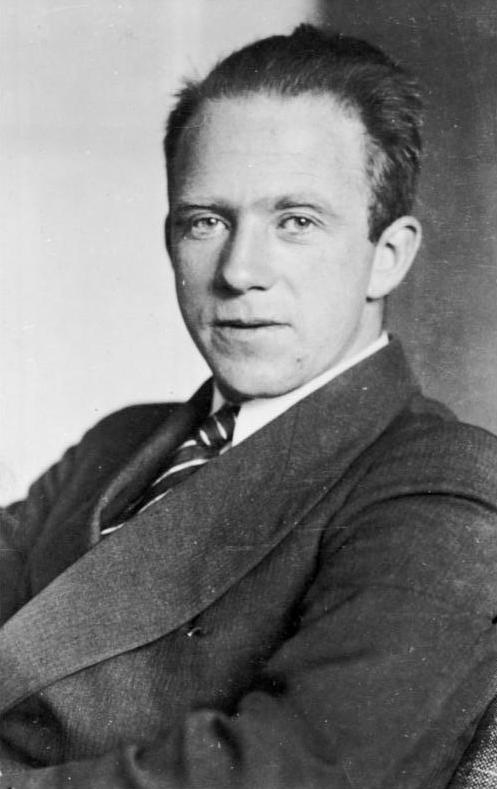
Werner Heisenberg
(From Wikipedia.com)
"[Werner Heisenberg and German biochemist Adolf Butenandt] had just attended a [March 1, 1943] meeting of the Academy for Aeronautics in the Air Ministry, off the Potsdamer Platz [in Berlin]. Hubert Schardin had been lecturing on the physiological effects of modern bombs, mentioning, among other things, that the sudden build-up of air pressure due to an explosion in one's immediate vicinity might lead to a relatively painless death from an embolism. Toward the end of the meeting, the alert had been sounded and all of us had made for the Ministry shelter, fitted out with camp beds and paillasses. This was our first experience of very heavy bombing. Several bombs hit the building of the Ministry, we heard the collapse of walls and ceilings, and for a time we did not know whether the corridor between our shelter and the outside world was still open.
Otto Hahn (From www.biography.com)
The lights had gone out shortly after the start of the raid, and there were occasional gleams of a flashlight. A groaning woman was brought in and tended by two medical orderlies. At first we had all been talking and even laughing, but gradually we fell silent; the only sound then was the occasional thud as yet another bomb dropped nearby. After two particularly violent bursts, with pressure waves that shook the whole shelter, I heard [German nuclear physicist] Otto Hahn pipe up in a corner: 'I bet Schardin doesn't believe in his own theories right now.' With that, the atmosphere grew just a shade less somber." (183)
--Werner Heisenberg, Physics and Beyond

Sunday, September 8, 2013

A "Super" Atom Bomb

Hydrogen Bomb (From: www.xtimeline.com)
"For Super was a bomb which might well be a thousand times as powerful as that which had razed Hiroshima to the ground. Unlike the ordinary atomic bomb it was an 'open-ended weapon,' of unrestricted range.

Such a bomb could be constructed only if the powerful natural processes taking place in the interior of the sun were successfully reproduced on earth. Quantities of energy were perpetually being released in that flaming heavenly body by the fusion of hydrogen atoms. The forces liberated were incomparably more powerful than those let loose in uranium fission...

[A group of nuclear physicists meeting at UC Berkeley, lead by Robert Oppenheimer,] indicated the possibility of a fusion of this kind, the logical next step after the fission bomb...

One of the questions to be considered was peculiarly sinister. The possibility had been mentioned at Berkeley that once the thermonuclear processes had been set in motion by the explosion of a bomb, they might affect the atmosphere and the waters of the earth. An irresistible global chain reaction might be released by the Super, which would transform the entire planet in a short time into a flaming and dying star." (265-266) --Robert Jungk, Brighter Than a Thousand Suns: A Personal History of the Atomic Scientists

Thursday, September 5, 2013

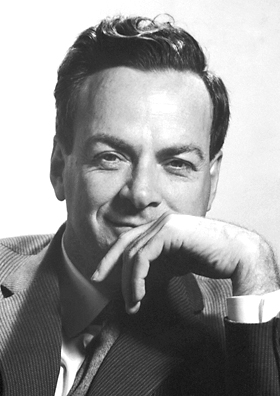
Guess who?

Richard Feynman (From Wikipedia)
"The enfant terrible among the atomic scientists was the theoretical physicist Richard Feynman, as young as he was gifted. To enrage the censors he instructed his wife to send him letters to Los Alamos which were torn into hundreds of small pieces. The officials charged with the checking of correspondence were obliged to fit all the fragments of this jigsaw puzzle together again. It also afforded Feynman great amusement to work out the combination numbers of the steel safes in which the most important data of research were kept. In one case he actually succeeded, after weeks of study, in opening the main file cupboard at the records center in Los Alamos while the officer in charge of it was absent for a few minutes. Feynman contented himself, in the brief period during which he had all the atomic secrets at his disposal, with placing in the safe a scrap of paper on which he had written, 'Guess who?' He was then able to feast his eyes on the horror of the security official as the latter perused the message which had found its way into the innermost sanctum of the Manhattan Project in some manner he was utterly unable to understand." (122) --Robert Jungk, Brighter Than a Thousand Suns: A Personal History of the Atomic Scientists

Sunday, September 1, 2013

"I want to do something risky."

Gottingen, Germany (From tripadvisor.com)
"From these [Gottingen, Germany host families] the foreign students often learned German very quickly. They frequently even wrote articles in German for scientific periodicals during the period of their studies. In conversation, however, they made amusing mistakes. The young English astrophysicist Robertson wanted one day to check the exact weight of a letter he was going to send abroad. He burst into a shop and breathlessly asked the girl behind the counter: 'Haben Sie eine Wiege? Ich mochte etwas wagen.' ('Have you a cradle? I want to do something risky.') The girl blushed and stared at him and he hastily corrected himself. 'I beg your pardon, I meant to say haben Sie eine Waage? Ich mochte etwas wiegen.' ('Have you a pair of scales? I want to weigh something.')" (22) --Robert Jungk, Brighter Than a Thousand Suns: A Personal History of the Atomic Scientists

Saturday, August 31, 2013

A Community of Atomic Physicists

"Young physicists from all over the world were studying [atomic physics] under Sommerfeld in Munich [in the early 1920s]. They even took their problems with them into the cafes.
This is a present-day cafe scene in the Hofgarten area of
Munich. (From Flickr: Maria Mia)
Marble-topped tables were covered with scribbled mathematical formulae. The waiters of the Cafe Lutz in the Hofgarten, regularly frequented by the Munich physicists, had strict instructions never to wipe the tables without special permission. For if a problem had not been solved by the time the cafe closed for the night, the further necessary calculations were carried out the following evening. It happened fairly often, moreover, that some unknown person would have the audacity to jot down the solution during the interval. Some young physicist would have been to too impatient to wait until the next meeting." (9) --Robert Jungk, Brighter Than a Thousand Suns: A Personal History of the Atomic Scientists