Sunday, October 12, 2014

Pigs in the Church

Coat of arms for the Corbin family,
of which I am a descendant.
(From: byandbylord.blogspot.com)
"The reality of privilege, by the seventeenth century, had virtually no connection at all with the medieval vision of an aristocracy of warriors whose qualities were said to be inherited, from father to son. Of those medieval knights, precious few still had descendants in possession of their ancestral fiefs in the sixteenth century. While the actual personnel of the medieval warrior caste was gone forever--the families having died out or lost their seigneurial rights--the trappings of chivalry, constantly reinterpreted, remained in place, secured by a steady flow of edicts from the royal palaces. Coats of arms were fabricated at short notice, for a price, by specialists in heraldry. The palaces and country houses of Europe were filled with phony dukes and marquises who asserted the antiquity of their privileges, which they did not hesitate to trace back to ancient Rome or even ancient Troy.

Newcomers to noble status, whether they had bought their fiefs in 1500 or in 1600, knew how to keep up appearances. They dressed the part. They built elaborate country houses. They maintained large numbers of retainers. They were presented at court. Their claims might arouse the suspicion of a handful of noblemen of older vintage, the king himself might laugh, privately, at their pretensions, but in public, as they made their way in silk-lined coaches toward masked balls and other expensive entertainments, who could deny their eminence?

Were they not received at court? Were they not lords among their peasants? Were they not set apart from commoners by their expensive wigs, their fashionable clothes, their perfumed gloves, the jeweled swords which hung from their belts? Participants in a ballet of deference, the noblemen and would-be noblemen of the seventeenth and eighteenth centuries were constantly removing and replacing their wide-brimmed hats, acknowledging the superior rank of a duke or president, receiving the homage of their own presumed inferiors. Bowing and scraping, insisting on their prerogative to remain seated or to keep their hats on, attended by servants and pushing their way into the place they felt entitled to on public occasions, hordes of men and women insisted on their various and conflicting positions in the world of privilege. They came to blows, at church, over the right to be seated in the front benches. 'They are like pigs,' wrote a country priest. 'Like pigs, they tear each other up. They have nothing but contempt for each other, they think that they can add weight to their own reputation by accusing others of being of more recent nobility.' Since privilege was largely a matter of wealth and of appearances [not birth], it is not surprising that appearances mattered so much. Kings set the tone, establishing elaborate hierarchies at court. At the royal palace in Versailles, thousands of courtiers lived in fear of committing breaches of etiquette, clinging to bewildering distinctions of rank. It was bad manners to knock at a door in Versailles. The proper way was to scratch at the door with the little finger of the left hand. If the servant of a social superior brought you a message, you had to receive him standing and bareheaded. If you encountered the royal dinner on its way from the kitchens to the table, you were obliged 'to bow as to the King himself, sweeping the ground with your hat and saying, in a low, reverent, but distinct voice: 'The King's dinner.' Who could sit down, in the presence of whom, and on what, was a vexing problem at court. Two prominent people could not meet without verifying the seating arrangements in advance. A fifteen-year-old duchess, elevated by her recent marriage to a rank which made her superior to her own mother, has a screaming fit when the usher on duty throws open both leaves of the door as her mother enters the room. As her social inferior, the mother was entitled only to one half of the door being opened for her." (63) --George Huppert, After the Black Death: A Social History of Early Modern Europe

I am descended from the Corbin family, which has its own coat of arms, pictured above. Therefore, I hereby assert my full privileges. I am declaring myself tax-exempt and demand that you not read this blog while you are sitting on the toilet or riding the bus. Such action would not be respectful to my rank.

Saturday, October 11, 2014

The Giraffe? It Stinks

Sienese district or ward flags. (From: Wikipedia)
"An extreme example of a city where ward membership has provoked passionate feelings since the thirteenth century is that of the Italian city of Siena. Each Sienese ward still has its own flag today, its colors, its symbols. There is the ward of the Eagle, the ward of the Snail, Owl, Tortoise, Giraffe, Goose--and so on. The modern Sienese still know precisely where the boundaries of their wards are drawn. Being 'of the Goose' or 'of the Giraffe' is a matter of great importance in Siena. Children are brought up to be proud of their own ward and contemptuous of rival ones. A Giraffe mother will spoon-feed her baby, saying 'One for mummy, one for daddy, one for the Giraffe.' The same mother will then condition the child to dislike the rival ward of the Caterpillar by saying: 'And this one is for the Caterpillar,' only to withdraw the spoon quickly, just as the baby opens its mouth. A two-year-old boy wearing a scarf with the Caterpillar colors is asked his name. 'Marco,' he says. 'And how old are you?' is the next question. Marco holds up two fingers. Then he is asked: 'How is the Caterpillar?' 'Bello [It is beautiful],' he replies. 'And what about the Giraffe?' 'It stinks,' says the child." (36) --George Huppert, After the Black Death: A Social History of Early Modern Europe

Saturday, September 6, 2014

Pass Some of that Spicy Sauce, Please!

A spice market in Istanbul. (From: Wikipedia)
"The twentieth-century American, taking for granted refrigeration, ease and rapidity of transport, and the resulting extraordinary variety of diet, may find perplexing his ancestors' lust for spices. We must remember some of the foods Europeans lacked. They had no rice, no corn, no potatoes; little cheese or butter; fresh fruits and green vegetables only in season, and few of these in the larger cities; almost no sugar. Fresh meat was relatively plentiful at the moment of massive slaughter in the autumn. At other times of year meat was salted and more than a little high; and since its source was excess work animals, it was hardly of prime quality. The ordinary diet was based on bread and gruel, enlivened by pickled cabbage, turnips, peas, lentils, and onions. The entire art of cookery lay in the sauce, and the piquancy of the sauce lay in its spices. Men wanted spices because they teased the palate, disguised the disagreeable or dull, gave variety to the menu. They wanted them for medicines and drugs, for perfumes and for use in religious ceremonies. The result was a most powerful demand for camphor, cinnamon, nutmeg, ginger, mace, cardamom, and, above all, for pepper and cloves--all products of Asia and excessively rare in Europe." (36) --Eugene F. Rice, Jr. and Anthony Grafton, The Foundations of Early Modern Europe, 1460-1559 2nd edition

I might also add that medieval Europeans had no tomatoes. Tomatoes are native only to South America. So, for hundreds and hundreds of years before the 16th century, Italian cooks had no tomatoes!

Saturday, August 16, 2014

St. Nicholas Hails from Tug Hill

Clement Clark Moore (From: Wikipedia)
Clement Clarke Moore wrote "Twas the Night Before Christmas" in 1822. This was the first popular culture item to conceive of St. Nicholas in the contemporary manner of a big man in a red suit with a sleigh pulled by a reindeer and gifts for all the good little boys and girls. The cartoonist Thomas Nast was inspired by Moore's poem to draw St. Nicholas. His were the first pictures of the new Santa Claus. These are all well-known facts of 19th century Christmas history. What is not precisely known is where Moore was when he wrote the poem. This is of crucial significance because proponents of one or the other location adduce a number of inspirations for the poem based on where they believe Moore wrote it. There are two possible locations: 1) Constableville, New York, or 2) Greenwich Village, New York City.

"Involved in the debate is Constable Hall, a stately limestone mansion in the rugged Tug Hill Country of northern New York state, far from Moore's New York City home. One 'Historic Museum Guide' for New York states with full conviction: 'It was at Constable Hall in 1822 that Clement Clark Moore, a first cousin of William Constable, Jr.'s widow, wrote "A Visit from St. Nicholas," which is popularly known today as "Twas the Night Before Christmas.' 

Constable Hall, Constableville, New York
(From: Constable Hall Museum)
"A second opinion relating to the Constables has subsisted through the years. Some believe that although Moore was not present in the Hall at the time of its writing, the poem was intended as a gift for the Constable children whose father had earlier died to an accident during the building of the elegant home...

"And from where did Clement Moore draw inspiration for the poem? Again, opinions seem to vary with the source.

"Constable Hall was built in Lewis County by William Constable Jr. on a vast expanse of land inherited from his father. Constable's wife, Mary Eliza McVicker Constable, was a first cousin of Clement Moore and his visits there are documented. 

"A 1998 Palm Beach Post newspaper story contends that on one such visit Moore encountered a Dutch gardener named Pieter, 'plump and jolly' and perhaps the inspiration for Santa Claus according to one of the last generation of Constables to live in the Hall. The account implies that physical features of the Hall, such as a large chimney and interior shutters in each room, are suggested in the poem." (338-339) --James Hughes, "Those Who Passed Through: Unlikely Visits to Unlikely Places," New York History, Vol. 91, No. 4 (Fall 2010)

Thomas Nast's 1881 Drawing of St. Nicholas
(From: St. Nicholas Center)
Wait a second... the Palm Beach Post?? Hughes rests content with the Palm Beach Post as a source?! I found Hughes' article fascinating because (sad to say) I have never heard of this story of Moore and Tug Hill before. I was glad to read the article. But I am disappointed to see a writer published in New York History citing a contemporary newspaper as his final source of information on a historical matter. I think we could all agree that a published article in a history journal should dig deeper than a current newspaper source.

Nevertheless, what a great story! I cannot wait to visit Constable Hall the next time I go back to northern New York!  

(By the way, Hughes goes into equal depth in the article on the possibility of Greenwich Village as the location for Moore's creativity. But, despite my love for New York City, I'm giving the limelight to Tug Hill because limelight does not shine on Tug Hill very often.)

Friday, August 15, 2014

The Real Meaning of "Manhattan"

Oak-Hickory Forest (From: Wikipedia)
"The Moravian missionary John Heckewelder reported an Indian tradition that when the Dutch first landed on Manhattan Island they gave liquor to the local inhabitants, as a consequence of which 'the Delawares call this place (New-York Island) Mannahattanink or Mannahachtanink to this day,... the same as to say, the island or place of general intoxication.' Another version, published earlier but evidently somewhat revised, has this as a tradition among the Delawares and the Mahicans that they named the island 'Manahachtanienk' meaning 'the island where all became intoxicated.' The story does not agree with known facts, notably the existence of the name already at the time of Hudson's voyage [long before the Dutch arrived], if not before, and the translation is nothing more than a folk etymology... (283)

The Mannahatta Project, which reconstructs the natural history of Manhattan as of 1609, has spread the claim that the name used by the local Lenape Indians was Mannahatta and meant 'island of many hills.' In fact, the spelling 'Mannahatta' is taken from a poem by Walt Whitman and does not mean in any spelling 'island of hills' let alone 'island of many hills'..." (287) --Ives Goddard, "The Origin and Meaning of the Name 'Manhattan,'" New York History, Vol. 91, No. 4 (Fall 2010)

Goddard bolsters his argument as to the incorrectness of both of the above proposed meanings (and others) with extended historical and linguistic arguments. So, what does "Manhattan" mean, according to Goddard? The original Native American inhabitants of Manhattan were Munsees. Their language was Munsee, part of the major linguistic group of Algonquins. Goddard locates the meaning of "Manhattan" as they themselves used it by focusing on the report of Albert Anthony, a 19th century Munsee Indian living on a reservation in Ontario. Anthony provided the Munsees' traditional explanation of "Manhattan" (the following is a quote of Anthony):

"Our traditions affirm that at the period of the discovery of America, our Nation resided on the Island of New York. We call that island Man-a-ha-tonh, The place where timber is procured for bows and arrows. The word is compounded of N'man-hum-in, I gather, and tan-ning, at the place. At the lower end of the island was a grove of hickory trees of peculiar strength and toughness. Our fathers held this timber in high esteem as material for constructing bows, war-clubs, etc." (289)

I am always fascinated to read about the natural history of Manhattan before the European exploration. The contrast between the current and pre-European landscapes could not be greater. The natural order here is almost completely obliterated. Think of it: a grove of hickory trees in lower Manhattan. Amazing!

Monday, August 11, 2014

Football and Bull Fights

"It has been said, not inaptly, that the relation of football to physical culture is much the same as that of the bull-fight to agriculture." (160) --Thorstein Veblen, The Theory of the Leisure Class (1994 Dover edition)

Veblen was not much of a football fan, was he? He wrote this in 1899. If you haven't read any Victorian texts recently, "physical culture" was the term then used for exercise and maintaining good physical fitness. Veblen's larger point is that football accentuates archaic human traits of predation and barbarism that are little economic use to a society. His ideas were part of the popular late 19th century ideology of social evolution. (You are probably more familiar with Herbert Spencer as social evolution's main advocate.) Veblen thought the evolution of the human species is driven by the natural selection of traits that enable humanity to progressively produce more wealth. For Veblen, it all comes down to whether certain human traits are useful in an economic sense. Apparently, football does not make the cut!

The Theory of the Leisure Class is a classic of economics and sociology. I would recommend it for its unique descriptions and explanations of Victorian upper class society--which, by the way, can be largely adapted to Americans of all classes today. His observations of the upper class's "conspicuous consumption" help one to understand why contemporary Americans (and probably all of Western society) are obsessed with consuming goods--cars, clothing, houses, etc--in order to remain "respectable" to their neighbors. However, Veblen's book is awfully convoluted. The organization of his arguments within chapters is sometimes hard to distinguish. I think he could have written this book using half the number of pages--and been better off for it.    

Monday, August 4, 2014

Drinking Health to King Jesus

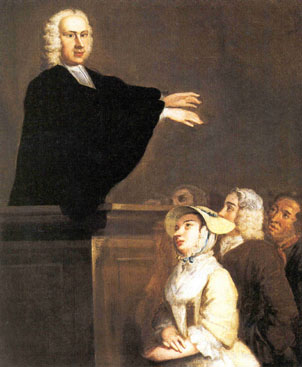
George Whitefield, whose preaching in 1740
began theGreat Awakening.
(From www.nndb.com)
The Great Awakening was "the boisterous and often fractious religious revivals that gripped New England following George Whitefield's celebrated preaching tour of 1740. Partisans of the Whitefieldian awakenings frequently referred to local events in places such as Newbury [Mass.] as a 'surprising,' 'extraordinary,' 'Glorious,' 'Marvelous,' and 'wonderfull' outpouring of God's Holy Spirit. More often, they simply called it 'the Work'...

"[In 1744], a Rowley [Mass.] layman named Richard Woodbury descended on Newbury, accompanied by Daniel Rogers and Nicholas Gilman. Together, they spent more than a month laboring to stir up fervent revival advocates in the town's two largest parishes. Woodbury claimed to possess the 'Power to bless and curse eternally whom he pleased.' He dared to drink 'healths to King Jesus' and vehemently condemned to hell anyone who questioned his charismatic authority. Exhibiting what one report called a 'strange Emotion,' Woodbury frequently fell into trances during which he would roll on the floor and rail against revival opposers, crying out that they had crucified Christ. Other reports suggested that he and his disciples bent to the ground and made crosses in the dust, before kissing and licking the earthen symbols." (65)  --Douglas L. Winiarski, "The Newbury Prayer Bill Hoax: Devotion and Deception in New England's Era of Great Awakenings," Massachusetts Historical Review, Vol. 14 (2012)

I should hasten to add in fairness that George Whitefield, John Wesley, and Jonathan Edwards, all closely associated with the First Great Awakening, would all have strongly disapproved of the sort of madness described above. There were both respectable and disreputable aspects of the First Great Awakening. Needless to say, Woodbury, Rogers, and Gilman represented the wilder side.