Sunday, October 11, 2015

Sugar, the Health Supplement

Vermont maple sugar
(From: Vermont Maple Sugar Makers Association)
"The plentiful use of sugar in diet, is one of the best preventives that has ever been discovered of the diseases which are produced by worms. The Author of Nature seems to have implanted a love of the aliment in all children, as if it were on purpose to defend them from those diseases. I know a gentleman in Philadelphia, who early adopted this opinion, and who by indulging a large family of children, in the use of sugar, has preserved them all from the diseases usually occasioned by worms." (288) --Benjamin Rush, "An Account of the Sugar Maple-Tree," Essays, Literary, Moral and Philosophical

Although here referring to the perceived benefits of sugar in general, Rush's whole essay was meant to promote the domestic production of sugar from the plentiful sugar maple trees in the new United States. What a great thing it must have been to be the children of that "Philadelphia gentleman"! At least, that is, until all that sugar started to rot their teeth.

Thursday, October 8, 2015

A Federal Office of Peace

Benjamin Rush, a Philadelphia physician and American founding father (he signed the Declaration of Independence), wrote an essay in the late-18th century entitled "A Plan of a Peace-Office for the United States." He gives several arguments for a new federal office of peace, then proceeds to describe the physical quarters of the peace office--as well as those of the federal office of war.

"In the last place, let a large room, adjoining the federal hall, be appropriated for transacting the business and preserving all the records of this office. Over the door of this room let there be a sign, on which figures of a LAMB, a DOVE and an OLIVE BRANCH should be painted, together with the following inscriptions in letters of gold:

PEACE ON EARTH--GOOD-WILL TO MAN.
AH! WHY WILL MEN FORGET THAT THEY ARE
BRETHREN?

Within this apartment let there be a collection of ploughshares and pruning-hooks made out of swords and spears; and on each of the walls of the apartment, the following pictures as large as the life:
1. A lion eating straw with an ox, and an adder playing upon the lips of a child.
2. An Indian boiling his venison in the same pot with a citizen of Kentucky.
3. Lord Cornwallis and Tippoo Saib, under the shade of a sycamore-tree in the East Indies, drinking Madeira wine together out of the same decanter. 
4. A group of French and Austrian soldiers dancing arm in arm, under a bower erected in the neighborhood of Mons. 
5. A St. Domingo planter, a man of color, and a native of Africa, legislating together in the same colonial assembly. 

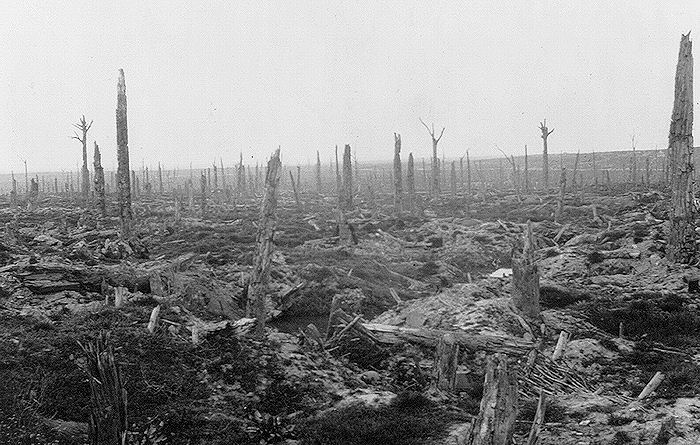
A former forest at Flanders Field in Belgium, after repeated
artillery shellings during World War I.
(From: TheHistoryPlace)
To complete the entertainment of this delightful apartment, let a group of young ladies, clad in white robes, assemble every day at a certain hour, in a gallery to be erected for the purpose, and sing odes, and hymns, and anthems in praise of the blessings of peace. 

One of these songs should consist of the following lines.


Peace o'er the world her olive wand extends,
And white-rob'd innocence from heaven descends;
All crimes shall cease, and ancient frauds shall fail, 
Returning justice lifts aloft her scale.

In order more deeply to affect the minds of the citizens of the United States with the blessings of peace, by contrasting them with the evils of war, let the following inscriptions be painted upon the sign, which is placed over the door of the War Office.
1. An office for butchering the human species. 
2. A Widow and Orphan making office.
3. A broken bone making office.
4. A Wooden leg making office.
5. An office for creating public and private vices. 
6. An office for creating a public debt. 
7. An office for creating speculators, stock Jobbers, and Bankrupts. 
8. An office for creating famine.
9. An office for creating pestilential diseases. 
10. An office for creating poverty, and the destruction of liberty, and national happiness. 

In the lobby of this office let there be painted representations of all the common military instruments of death, also human skulls, broken bones, unburied and putrifying dead bodies, hospitals crouded with sick and wounded Soldiers, villages on fire, mothers in besieged towns eating the flesh of their children, ships sinking in the ocean, rivers dyed with blood, and extensive plains without a tree or fence, or any other object, but the ruins of deserted farm houses. 

Above this group of woeful figures,--let the following words be inserted, in red characters to represent human blood, 

'NATIONAL GLORY'"

--Benjamin Rush, "A Plan of a Peace-Office for the United States." Essays, Literary, Moral and Philosophical


Sunday, October 4, 2015

A Slippery Slope from Latin Lesson Avoidance to a Life of Crime

Benjamin Rush (From: Wikipedia)
"Many sprightly boys of excellent capacities for useful knowledge, have been so disgusted with the dead languages, as to retreat from the drudgery of schools, to low company, whereby they have become bad members of society, and entailed misery upon all who have been connected with them." (24)
--Benjamin Rush, "Observations Upon the Study of the Latin and Greek Languages..." Essays, Literary, Moral and Philosophical

Benjamin Rush, you will recall, is one of the founding fathers, having signed the Declaration of Independence. He was a physician from Philadelphia, Pennsylvania. His entire essay on the dead languages, published in the above collection in 1798, is an argument for why students up to the age of eighteen should not study Latin and Greek. The crux of his argument is that knowledge of these languages is not "useful." The only time when Greek was useful, he says, was when Greek children were learning it in their ancient schools. He brings all the argumentative ammunition he can summon to his task, including more unlikely propositions such as the one above.

Saturday, July 18, 2015

Railroad Pie

In the mid-19th century, most trains would stop for 20-30 minutes at mealtimes in whatever city or town they happened to be passing through. In the cities, competition between multiple eating establishments seems to have raised the quality of the food. However, the majority of these meal stops were made in places where hungry passengers had few options to choose from and a short time to do it. With no competition, one can only imagine the poor quality of food offered to captive passengers. Food historian James D. Porterfield describes the offered repasts:
James D. Porterfield, Dining by Rail:
The History and Recipes of America's
Golden Age of Railroad Cuisine

"These early eating stops were nearly always described as terrible. The bitter black coffee may have been brewed only once a week. The ham could be dry, salty, and tough. Hard-cooked eggs were stored for an indeterminate period of time in limed water to keep them from discoloring. Fried eggs may have been cooked in rancid grease and certainly were served on stale bread. Here also one found leaden biscuits--their nickname, 'sinkers', giving a clue as to their quality--and something which earned the euphemism 'railroad pie'. The recipe was thought to be to take two crusts of cardboard and fill them with thickened glue." (58) --John P. Hankey, "Riding on the Rail,"  Rails Across America: A History of Railroads in North America, quoting James D. Porterfield's Dining by Rail: The History and the Recipes of America's Golden Age of Railroad Cuisine

Friday, July 17, 2015

Traveling at "the heady speed of 18mph"

In 1830, Peter Cooper, a New York businessman, invested in an experimental steam locomotive, the Tom Thumb, to prove that steam power was a viable option for moving passengers and goods by rail. Investors in the Baltimore & Ohio Railroad believed that the sharp curves on their tracks precluded the use of a steam locomotive.
A 1927 replica of the locomotive "Tom Thumb."
(From: Wikipedia)

"Cooper set out to prove them wrong. His engine, assembled by a team of Baltimore mechanics, weighed about one ton, and was not much larger than a railroad handcar. The locomotive boasted a vertical, multi-tubular boiler, a single cylinder, drive gears, and rode on the 'friction wheels' designed by Ross Winans, who compared the engine's power favorably to the Rocket [a British steam locomotive predating the Tom Thumb]. With Cooper at the controls, the engine managed to achieve the heady speed of 18 mph; some of the passengers pulled out notebooks and wrote down their thoughts to prove that human beings could function normally at such high velocities." (10) --James D. Dilts, "The Early Days," Rails Across America: A History of Railroads in North America, William L. Withuhn, ed.

Thursday, July 16, 2015

"Do Not Trust My Wife"

A notice placed in a Boston newspaper in January 1777: "I, John Whitehead, of Weston, for several Reasons, forbid all Persons trusting ANNA, my wife, any Thing whatsoever, on my Account; as I declare I will not pay any Debt she may contract after the Date hereof." --Richard C. Wiggin, "Embattled Farmers: Tracing Revolutionary Soldiers from Lincoln, Massachusetts," American Ancestors, Spring 2015 issue

Sunday, July 5, 2015

Johnny Appleseed(s) of Pot

"By [the mid-1970s], the American backwoods were filling with self-styled Johnny Appleseeds sowing cannabis seeds far and wide as they dreamed of a new Utopia of the Stoned. (The phrase 'Johnny Appleseed of Pot' recently produced nearly ten thousand hits on Google.)" (268) --Howard Means, Johnny Appleseed: The Man, The Myth, The American Story

Johnny Appleseed (From: Wikipedia)
Means published this book in 2011, so his Google search is somewhat outdated. I searched for the phrase "Johnny Appleseed of Pot" and received just 214 results--all highly entertaining by the way. If you search without the phrase quotes, then you get 129,000 results; but this is misleading because there are a number of websites that talk about the pot, as in a metal pan, that Johnny Appleseed wore on his head--in other words, nothing to do with the other kind of "pot."

I don't know about the 1970s, but as recently as 2005, there was a "Johnny Appleseed of Pot" in Benzie County, Michigan. This specialty nurseryman would search for ideal places to plant marijuana, no matter who the landowner was, sow his seeds, then check back later to tend them. Exactly the pattern used by the real Johnny Appleseed!