Sunday, May 7, 2017

Sunday Services in "The Coffin"

"At least one meeting house in New England earned the name 'The Coffin' because its unpainted clapboards reportedly turned black under the effect of weathering." (55) --Peter Benes, "Sky Colors and Scattered Clouds: The Decorative and Architectural Painting of New England Meeting Houses, 1738-1834" in Peter Benes, ed. New England Meeting House and Church: 1630-1850
Appearing in a much happier color,
Colonial Meeting House, Cohasset, Mass.
(From: Wikimedia)


Picture in your mind a rural New England landscape with a church. Your mind is probably picturing that church with white paint. Mine does, anyway. But your mind's eye in that case would only be accounting for church decor from the 1830s onwards. The white color is a product of the Greek Revival architectural movement that arrived in New England around that time. Prior to this decade, New England meeting houses and churches could be seen in an amazing variety of colors in addition to white. The most popular paints for these public buildings in the 18th century were, in order of popularity: 1) yellow or light yellow, 2) white, 3) gray, 4) blue, 5) red, 6) orange, and 7) green. As unappealing as a black colored meeting house called "The Coffin" seems today, it must have had an even greater affective impact in a time when so many other churches were painted in brighter, happier colors.

Benes does not mention where this meeting house called "The Coffin" was located, so we don't know much about the theology of the preaching that was done there. However, consider the possibility of walking into "The Coffin" on a Sunday morning and hearing a sermon such as Jonathan Edwards's "Sinners in the Hands of an Angry God"!

Sunday, May 8, 2016

This World is One Big Heape of Dung

The historian Edmund Morgan describes a conversation between Massachusetts Bay Colony governor John Winthrop and Roger Williams, the separatist and future resident of Providence, Rhode Island (after being banned from Massachusetts).

"[Roger Williams] did indeed think that the Lord had forsaken New England for failing to separate her churches wholly from the filthiness of English corruption. And to [John] Winthrop he offered the very advice that Winthrop could least willingly listen to. Where Winthrop had urged him to pause and consider whether everyone was wrong but him, he replied with an invitation to join him in splendid isolation: 'Abstract yourself,' he urged, 'with a holy violence from the Dung heape of this Earth.' Williams would not learn the lesson which Winthrop had taught himself so painfully before he left England, that there was no escape from the dung heap of this earth; and that those who sought one or thought they had found it acted with an unholy, not a holy, violence."
Roger Williams (From: Wikimedia)

Morgan explains a series of stages Williams passed through to purify himself by associating only with other righteous people. The final stage was Williams' conclusion that "he could not conscientiously have communion with anyone but his wife... He had effectively demonstrated the proposition to himself as he withdrew successively from the Church of England, from the churches of Massachusetts, and finally from everyone but his wife. What he saw at last was what Winthrop had tried to point out to him, that he was seeking an unattainable goal, that there was no escape from the dung heap of this earth."

After reaching this conclusion, Williams progressed to a radically new position of extreme tolerance. Or, as Morgan tells us, "since he could not escape the dung heap, he would embrace it."

Why did I share this with you? Because I am fascinated by the metaphor of this world as a heap of dung. No other reason (besides the fact that I enjoy early New England history)!

--quotes are taken from Edmund Morgan, The Puritan Dilemma: The Story of John Winthrop, pp. 120-131

Saturday, March 5, 2016

An Alcoholic Cod

"During Prohibition, fishermen, like everyone else, had to find ways to supplement their meager income. One way for a lobsterman to do so was to turn to a bit of low-level rum-running. The lobsterman would place orders in notes in his traps and then retrieve the traps a day or two later. In them he found, in place of the notes, peculiar lobsters... in the shape of bottles of booze...
Atlantic Cod (From: Wikipedia)

In July 1929 three Isleboro [Maine] fisherman, in outer Penobscot Bay, pulled in a seventy-pound cod. When dressing it, they found a sealed full-size bottle of bootleg whiskey in its gut. Cod are notorious for swallowing anything within reach--and this bottle, no doubt, was pitched overboard by a rumrunner being pursued, perhaps even a rum-running lobsterman." (230) --Matthew P. Mayo, Bootleggers, Lobstermen & Lumberjacks: Fifty of the Grittiest Moments in the History of Hardscrabble New England 

Monday, February 15, 2016

How to Detect Pregnancy in 18th Century America

Dr. George DeBenneville
(From: U.S. National Library of Medicine)
"In describing the symptoms of pregnancy to his married daughter, Harriet, the eminent Dr. George DeBenneville [a respected American doctor] never mentioned the cessation of menstruation, listing instead 'coldness of the outward parts,' that 'the Belly waxeth very flat,' that 'the Veins of the eyes are clearly seen,' and, finally, the appearance of a 'small living creature' in urine that had been stored for thirteen days." (201) --Stephanie Grauman Wolf, As Various as their Land: The Everyday Lives of Eighteenth-Century Americans

Sunday, January 10, 2016

Say "Justification by Faith", or I Pull Your Beard!

The Council of Trent (From: Wikipedia)
At the Catholic Church's Council of Trent around 1545: "After passing various reform decrees on preaching, catechetical instruction, privileges of mendicants and indulgences, the council took up the thorny question of justification. Discussion was postponed for some months out of consideration for the emperor, who feared it might irritate the Protestants, and only gave his consent to it in the hope that some ambiguous form acceptable to that party, might be found. How deeply the solifidian doctrine had penetrated into the very bosom of the church was revealed by the storminess of the debate. The passions of the right reverend fathers were so excited by the consideration of a fundamental article of their faith that in the course of disputation they accused one another of conduct unbecoming to Christians, taunted one another with plebeian origin and tore hair from one another's beards." (297) --Preserved Smith, Reformation in Europe

Friday, December 25, 2015

"Direct Revelation" Says: No Immaculate Conception

"Berne [Switzerland] was the theater of one of the most reverberating scandals enacted by the contemporary church. A passionately contested theological issue of the day was whether the Virgin had been immaculately conceived. This was denied by the Dominicans and asserted by the Franciscans. Some of the Dominicans of the friary at Berne thought that the best way to settle the affair was to have a direct revelation. For their fraudulent purposes they conspired with John Jetzer, a lay brother admitted in 1506, who died after 1520. Whether as a tool in the hands of others, or as an imposter, Jetzer produced a series of bogus apparitions, bringing the Virgin on the stage and making her give details of her conception sufficiently gross to show that it took place in the ordinary, and not in the immaculate, manner. When the fraud was at last discovered by the authorities, four of the Dominicans involved were burnt at the stake." (121) --Preserved Smith, Reformation in Europe

Tuesday, December 22, 2015

Financing Salvation in the Early 16th Century

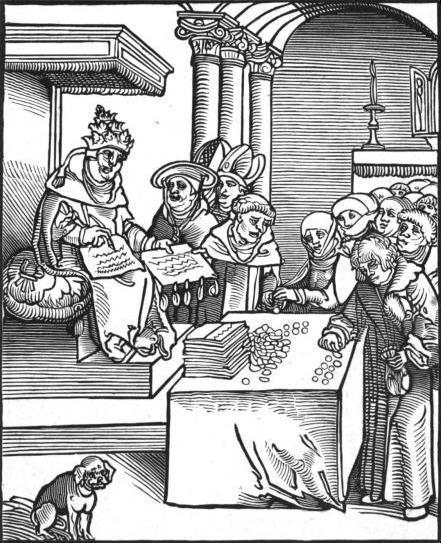
"One of the richest sources of ecclesiastical revenue was the sale of indulgences, or the remission by the pope of the temporal penalties of sin, both penance in this life and the pains of purgatory. The practice of giving these pardons first arose as a means of assuring heaven to those warriors who fell fighting the infidel. In 1300 Boniface VIII granted a plenary indulgence to all who made the pilgrimage to the jubilee at Rome, and the golden harvest reaped on this occasion induced his successors to take the same means of imparting spiritual graces to the faithful at frequent intervals. In the fourteenth century the pardons were extended to all who contributed a sum of money to a pious purpose, whether they came to Rome or not, and, as the agents who were sent out to distribute these pardons were also given power to confess and absolve, the papal letters were naturally regarded as no less than tickets of admission to heaven. In the thirteenth century the theologians had discovered that there was at the disposal of the church and her head an abundant 'treasury of the merits of Christ and the saints,' which might be applied vicariously to anyone by the pope. In the fifteenth century the claimed power to free living men from purgatory was extended to the dead, and this soon became one of the most profitable branches of the 'holy trade.'
The Pope as the Antichrist, signing and selling
indulgences, from Luther's 1521 Pasional
Christi und Antichristi,
by Lucas Cranach the Elder (From: Wikipedia)

The means of obtaining indulgences varied. Sometimes they were granted to those who made a pilgrimage or who would read a pious book. Sometimes they were used to raise money for some public work, a hospital or a bridge. But more and more they became an ordinary means for raising revenue for the curia. How thoroughly commercialized the business of selling grace and remission of the penalties of sin had become is shown by the fact that the agents of the pope were often bankers who organized the sales on purely business lines in return for a percentage of the net receipts plus the indirect profits accruing to those who handle large sums. Of the net receipts the financiers usually got about ten percent; an equal amount was given to the emperor or other civil ruler for permitting the pardoners to enter his territory, commissions were also paid to the local bishop and clergy, and of course the pedlars of the pardons received a proportion of the profits in order to stimulate their zeal. On the average from thirty to forty-five percent of the gross receipts were turned into the Roman treasury." (29-30) --Preserved Smith, Reformation in Europe


Sunday, October 11, 2015

Sugar, the Health Supplement

Vermont maple sugar
(From: Vermont Maple Sugar Makers Association)
"The plentiful use of sugar in diet, is one of the best preventives that has ever been discovered of the diseases which are produced by worms. The Author of Nature seems to have implanted a love of the aliment in all children, as if it were on purpose to defend them from those diseases. I know a gentleman in Philadelphia, who early adopted this opinion, and who by indulging a large family of children, in the use of sugar, has preserved them all from the diseases usually occasioned by worms." (288) --Benjamin Rush, "An Account of the Sugar Maple-Tree," Essays, Literary, Moral and Philosophical

Although here referring to the perceived benefits of sugar in general, Rush's whole essay was meant to promote the domestic production of sugar from the plentiful sugar maple trees in the new United States. What a great thing it must have been to be the children of that "Philadelphia gentleman"! At least, that is, until all that sugar started to rot their teeth.

Thursday, October 8, 2015

A Federal Office of Peace

Benjamin Rush, a Philadelphia physician and American founding father (he signed the Declaration of Independence), wrote an essay in the late-18th century entitled "A Plan of a Peace-Office for the United States." He gives several arguments for a new federal office of peace, then proceeds to describe the physical quarters of the peace office--as well as those of the federal office of war.

"In the last place, let a large room, adjoining the federal hall, be appropriated for transacting the business and preserving all the records of this office. Over the door of this room let there be a sign, on which figures of a LAMB, a DOVE and an OLIVE BRANCH should be painted, together with the following inscriptions in letters of gold:

PEACE ON EARTH--GOOD-WILL TO MAN.
AH! WHY WILL MEN FORGET THAT THEY ARE
BRETHREN?

Within this apartment let there be a collection of ploughshares and pruning-hooks made out of swords and spears; and on each of the walls of the apartment, the following pictures as large as the life:
1. A lion eating straw with an ox, and an adder playing upon the lips of a child.
2. An Indian boiling his venison in the same pot with a citizen of Kentucky.
3. Lord Cornwallis and Tippoo Saib, under the shade of a sycamore-tree in the East Indies, drinking Madeira wine together out of the same decanter. 
4. A group of French and Austrian soldiers dancing arm in arm, under a bower erected in the neighborhood of Mons. 
5. A St. Domingo planter, a man of color, and a native of Africa, legislating together in the same colonial assembly. 

A former forest at Flanders Field in Belgium, after repeated
artillery shellings during World War I.
(From: TheHistoryPlace)
To complete the entertainment of this delightful apartment, let a group of young ladies, clad in white robes, assemble every day at a certain hour, in a gallery to be erected for the purpose, and sing odes, and hymns, and anthems in praise of the blessings of peace. 

One of these songs should consist of the following lines.


Peace o'er the world her olive wand extends,
And white-rob'd innocence from heaven descends;
All crimes shall cease, and ancient frauds shall fail, 
Returning justice lifts aloft her scale.

In order more deeply to affect the minds of the citizens of the United States with the blessings of peace, by contrasting them with the evils of war, let the following inscriptions be painted upon the sign, which is placed over the door of the War Office.
1. An office for butchering the human species. 
2. A Widow and Orphan making office.
3. A broken bone making office.
4. A Wooden leg making office.
5. An office for creating public and private vices. 
6. An office for creating a public debt. 
7. An office for creating speculators, stock Jobbers, and Bankrupts. 
8. An office for creating famine.
9. An office for creating pestilential diseases. 
10. An office for creating poverty, and the destruction of liberty, and national happiness. 

In the lobby of this office let there be painted representations of all the common military instruments of death, also human skulls, broken bones, unburied and putrifying dead bodies, hospitals crouded with sick and wounded Soldiers, villages on fire, mothers in besieged towns eating the flesh of their children, ships sinking in the ocean, rivers dyed with blood, and extensive plains without a tree or fence, or any other object, but the ruins of deserted farm houses. 

Above this group of woeful figures,--let the following words be inserted, in red characters to represent human blood, 

'NATIONAL GLORY'"

--Benjamin Rush, "A Plan of a Peace-Office for the United States." Essays, Literary, Moral and Philosophical


Sunday, October 4, 2015

A Slippery Slope from Latin Lesson Avoidance to a Life of Crime

Benjamin Rush (From: Wikipedia)
"Many sprightly boys of excellent capacities for useful knowledge, have been so disgusted with the dead languages, as to retreat from the drudgery of schools, to low company, whereby they have become bad members of society, and entailed misery upon all who have been connected with them." (24)
--Benjamin Rush, "Observations Upon the Study of the Latin and Greek Languages..." Essays, Literary, Moral and Philosophical

Benjamin Rush, you will recall, is one of the founding fathers, having signed the Declaration of Independence. He was a physician from Philadelphia, Pennsylvania. His entire essay on the dead languages, published in the above collection in 1798, is an argument for why students up to the age of eighteen should not study Latin and Greek. The crux of his argument is that knowledge of these languages is not "useful." The only time when Greek was useful, he says, was when Greek children were learning it in their ancient schools. He brings all the argumentative ammunition he can summon to his task, including more unlikely propositions such as the one above.

Saturday, July 18, 2015

Railroad Pie

In the mid-19th century, most trains would stop for 20-30 minutes at mealtimes in whatever city or town they happened to be passing through. In the cities, competition between multiple eating establishments seems to have raised the quality of the food. However, the majority of these meal stops were made in places where hungry passengers had few options to choose from and a short time to do it. With no competition, one can only imagine the poor quality of food offered to captive passengers. Food historian James D. Porterfield describes the offered repasts:
James D. Porterfield, Dining by Rail:
The History and Recipes of America's
Golden Age of Railroad Cuisine

"These early eating stops were nearly always described as terrible. The bitter black coffee may have been brewed only once a week. The ham could be dry, salty, and tough. Hard-cooked eggs were stored for an indeterminate period of time in limed water to keep them from discoloring. Fried eggs may have been cooked in rancid grease and certainly were served on stale bread. Here also one found leaden biscuits--their nickname, 'sinkers', giving a clue as to their quality--and something which earned the euphemism 'railroad pie'. The recipe was thought to be to take two crusts of cardboard and fill them with thickened glue." (58) --John P. Hankey, "Riding on the Rail,"  Rails Across America: A History of Railroads in North America, quoting James D. Porterfield's Dining by Rail: The History and the Recipes of America's Golden Age of Railroad Cuisine

Friday, July 17, 2015

Traveling at "the heady speed of 18mph"

In 1830, Peter Cooper, a New York businessman, invested in an experimental steam locomotive, the Tom Thumb, to prove that steam power was a viable option for moving passengers and goods by rail. Investors in the Baltimore & Ohio Railroad believed that the sharp curves on their tracks precluded the use of a steam locomotive.
A 1927 replica of the locomotive "Tom Thumb."
(From: Wikipedia)

"Cooper set out to prove them wrong. His engine, assembled by a team of Baltimore mechanics, weighed about one ton, and was not much larger than a railroad handcar. The locomotive boasted a vertical, multi-tubular boiler, a single cylinder, drive gears, and rode on the 'friction wheels' designed by Ross Winans, who compared the engine's power favorably to the Rocket [a British steam locomotive predating the Tom Thumb]. With Cooper at the controls, the engine managed to achieve the heady speed of 18 mph; some of the passengers pulled out notebooks and wrote down their thoughts to prove that human beings could function normally at such high velocities." (10) --James D. Dilts, "The Early Days," Rails Across America: A History of Railroads in North America, William L. Withuhn, ed.

Thursday, July 16, 2015

"Do Not Trust My Wife"

A notice placed in a Boston newspaper in January 1777: "I, John Whitehead, of Weston, for several Reasons, forbid all Persons trusting ANNA, my wife, any Thing whatsoever, on my Account; as I declare I will not pay any Debt she may contract after the Date hereof." --Richard C. Wiggin, "Embattled Farmers: Tracing Revolutionary Soldiers from Lincoln, Massachusetts," American Ancestors, Spring 2015 issue

Sunday, July 5, 2015

Johnny Appleseed(s) of Pot

"By [the mid-1970s], the American backwoods were filling with self-styled Johnny Appleseeds sowing cannabis seeds far and wide as they dreamed of a new Utopia of the Stoned. (The phrase 'Johnny Appleseed of Pot' recently produced nearly ten thousand hits on Google.)" (268) --Howard Means, Johnny Appleseed: The Man, The Myth, The American Story

Johnny Appleseed (From: Wikipedia)
Means published this book in 2011, so his Google search is somewhat outdated. I searched for the phrase "Johnny Appleseed of Pot" and received just 214 results--all highly entertaining by the way. If you search without the phrase quotes, then you get 129,000 results; but this is misleading because there are a number of websites that talk about the pot, as in a metal pan, that Johnny Appleseed wore on his head--in other words, nothing to do with the other kind of "pot."

I don't know about the 1970s, but as recently as 2005, there was a "Johnny Appleseed of Pot" in Benzie County, Michigan. This specialty nurseryman would search for ideal places to plant marijuana, no matter who the landowner was, sow his seeds, then check back later to tend them. Exactly the pattern used by the real Johnny Appleseed!

Friday, February 27, 2015

Not a "Pastime for Curious Women"

Edmands' smooth rocks of the Gulfside Trail.
(From: www.legacysailing.com)
In August 2014, I hiked the Presidential Range of the White Mountains. I noticed an interesting phenomenon a mile or two west of Madison Spring Hut on the Gulfside Trail. The rocks on the trail seemed perfectly placed to form a flat surface, as if forming an alpine highway. Compared to most of the other alpine trails on the trip, this piece of trail was easy to walk! It was like an alpine sidewalk. I asked a croo member at the hut what the explanation for this was. Who would have spent the immense amount of time and labor to place all those rocks just so?! I was told that J. Rayner Edmands, a famous trail builder of the early 20th century had laid out the Gulfside Trail. 

In the latest issue of the Appalachian Mountain Club's journal, Appalachia, I encountered more information about Edmands and his beautiful trails. Edmands had a trail-building rival in the Whites: Warren Hart, the Appalachian Mountain Club's Councillor of Trails. From 1909 to 1911, Hart blazed most of the trails now existent in the Great Gulf, a five thousand acre wilderness area enclosed by Mounts Washington, Clay, Jefferson, Adams, and Madison. Hart and Edmands had widely divergent trail building philosophies. For entertainment's sake, I'll let Hart describe these philosophies. He wrote a newspaper article in a 1909 issue of the Boston Evening Transcript.

Warren Hart (top) on the Six Husbands Trail
in the Great Gulf.
(From: whitemountainsojourn.blogspot.com)
"Unlike most of the paths in the White Mountains, these [Great Gulf] trails have not been cut to avoid obstacles, or to smooth them away as much as possible, they were not designed for the pastime of curious women; and they have not been made like to the superfluous boulevards of piled stone work that a perverted energy has built here and there upon the mountains..." (Appalachia, Winter/Spring 2015, 94-95)

I guess Hart was not a fan of Edmands' work, eh?


Monday, February 16, 2015

I Am Lovesick, Now Please Pass the Opium

Hector Berlioz (From: Wikipedia)
"When he was twenty-three, [Hector] Berlioz was overwhelmed by the works of Shakespeare and also fell madly in love with a Shakespearean actress, Harriet Smithson, to whom he wrote such wild, impassioned letters that she considered him a lunatic and refused to see him. To depict his 'endless and unquenchable passion,' Berlioz wrote the Symphonie fantastique (Fantastic Symphony) in 1830, which startled Parisians by its sensationally autobiographical program, its amazingly novel orchestration, and its vivid depiction of the weird and diabolical.

In 1830, too, Berlioz won the Prix de Rome (the Rome Prize), subsidizing two years' study in Rome; when he returned to Paris, he finally met and married Harriet Smithson--after she had attended a performance of the Fantastic Symphony and realized that it depicted her. (They separated, however, after only a few years.)" (241-242)

So, what exactly was in the Fantastic Symphony that won Berlioz the girl of his dreams? Here are some quotes from the program notes he wrote for his audience:

"A young musician of extraordinary sensibility and abundant imagination, in the depths of despair because of hopeless love, has poisoned himself with opium. The drug is too feeble to kill him but plunges him into a heavy sleep accompanied by weird visions. His sensations, emotions, and memories, as they pass through his affected mind, are transformed into musical images and ideas. The beloved one herself becomes to him a melody, a recurrent theme (idee fixee) which haunts him continually...

Harriet Smithson (From: Wikimedia)
[Notes for the Fourth Movement, March to the Scaffold] He dreams that he has murdered his beloved, that he was been condemned to death and is being led to the scaffold. The procession moves forward to the sounds of a march that is now somber and fierce, now brilliant and solemn, in which the muffled sounds of heavy steps give way without transition to the noisiest outbursts. At the end the idee fixee returns for a moment, like a last thought of love interrupted by the death blow...

[Notes for the Fifth Movement, Dream of a Witches' Sabbath] He sees himself at a witches' sabbath in the midst of a hideous crowd of ghouls, sorcerers, and monsters of every description, united for his funeral. Strange noises, groans, shrieks of laughter, distant cries, which other cries seems to answer. The melody of the loved one is heard, but it has lost its character of nobleness and timidity; it is no more than a dance tune, ignoble, trivial, and grotesque. It is she who comes to the sabbath!... A howl of joy greets her arrival... She participates in the diabolical orgy... The funeral knell, burlesque of the Dies irae. Witches' dance. The dance and the Dies irae combined." (243-246) --Roger Kamien, Music: An Appreciation

I hope all you lovesick young men are out there reading! If you really want the girl, write in a song in which you imagine murdering her and, after your trial and execution, discovering that she is a witch! Now that's a prescription for love. Hey, it worked for Berlioz.


Thursday, February 5, 2015

Banging Out Each Note

An illustration of a primitive, medieval organ from Medieval Life and People
by Carol Belanger Grafton.
"After about 1100... instruments were used increasingly in church. The organ was most prominent. At first, it was a primitive instrument; the keys were operated by heavy blows with the fists. It was so loud that it could be heard for miles around." (62) --Roger Kamien, Music: An Appreciation

Sunday, October 12, 2014

Pigs in the Church

Coat of arms for the Corbin family,
of which I am a descendant.
(From: byandbylord.blogspot.com)
"The reality of privilege, by the seventeenth century, had virtually no connection at all with the medieval vision of an aristocracy of warriors whose qualities were said to be inherited, from father to son. Of those medieval knights, precious few still had descendants in possession of their ancestral fiefs in the sixteenth century. While the actual personnel of the medieval warrior caste was gone forever--the families having died out or lost their seigneurial rights--the trappings of chivalry, constantly reinterpreted, remained in place, secured by a steady flow of edicts from the royal palaces. Coats of arms were fabricated at short notice, for a price, by specialists in heraldry. The palaces and country houses of Europe were filled with phony dukes and marquises who asserted the antiquity of their privileges, which they did not hesitate to trace back to ancient Rome or even ancient Troy.

Newcomers to noble status, whether they had bought their fiefs in 1500 or in 1600, knew how to keep up appearances. They dressed the part. They built elaborate country houses. They maintained large numbers of retainers. They were presented at court. Their claims might arouse the suspicion of a handful of noblemen of older vintage, the king himself might laugh, privately, at their pretensions, but in public, as they made their way in silk-lined coaches toward masked balls and other expensive entertainments, who could deny their eminence?

Were they not received at court? Were they not lords among their peasants? Were they not set apart from commoners by their expensive wigs, their fashionable clothes, their perfumed gloves, the jeweled swords which hung from their belts? Participants in a ballet of deference, the noblemen and would-be noblemen of the seventeenth and eighteenth centuries were constantly removing and replacing their wide-brimmed hats, acknowledging the superior rank of a duke or president, receiving the homage of their own presumed inferiors. Bowing and scraping, insisting on their prerogative to remain seated or to keep their hats on, attended by servants and pushing their way into the place they felt entitled to on public occasions, hordes of men and women insisted on their various and conflicting positions in the world of privilege. They came to blows, at church, over the right to be seated in the front benches. 'They are like pigs,' wrote a country priest. 'Like pigs, they tear each other up. They have nothing but contempt for each other, they think that they can add weight to their own reputation by accusing others of being of more recent nobility.' Since privilege was largely a matter of wealth and of appearances [not birth], it is not surprising that appearances mattered so much. Kings set the tone, establishing elaborate hierarchies at court. At the royal palace in Versailles, thousands of courtiers lived in fear of committing breaches of etiquette, clinging to bewildering distinctions of rank. It was bad manners to knock at a door in Versailles. The proper way was to scratch at the door with the little finger of the left hand. If the servant of a social superior brought you a message, you had to receive him standing and bareheaded. If you encountered the royal dinner on its way from the kitchens to the table, you were obliged 'to bow as to the King himself, sweeping the ground with your hat and saying, in a low, reverent, but distinct voice: 'The King's dinner.' Who could sit down, in the presence of whom, and on what, was a vexing problem at court. Two prominent people could not meet without verifying the seating arrangements in advance. A fifteen-year-old duchess, elevated by her recent marriage to a rank which made her superior to her own mother, has a screaming fit when the usher on duty throws open both leaves of the door as her mother enters the room. As her social inferior, the mother was entitled only to one half of the door being opened for her." (63) --George Huppert, After the Black Death: A Social History of Early Modern Europe

I am descended from the Corbin family, which has its own coat of arms, pictured above. Therefore, I hereby assert my full privileges. I am declaring myself tax-exempt and demand that you not read this blog while you are sitting on the toilet or riding the bus. Such action would not be respectful to my rank.

Saturday, October 11, 2014

The Giraffe? It Stinks

Sienese district or ward flags. (From: Wikipedia)
"An extreme example of a city where ward membership has provoked passionate feelings since the thirteenth century is that of the Italian city of Siena. Each Sienese ward still has its own flag today, its colors, its symbols. There is the ward of the Eagle, the ward of the Snail, Owl, Tortoise, Giraffe, Goose--and so on. The modern Sienese still know precisely where the boundaries of their wards are drawn. Being 'of the Goose' or 'of the Giraffe' is a matter of great importance in Siena. Children are brought up to be proud of their own ward and contemptuous of rival ones. A Giraffe mother will spoon-feed her baby, saying 'One for mummy, one for daddy, one for the Giraffe.' The same mother will then condition the child to dislike the rival ward of the Caterpillar by saying: 'And this one is for the Caterpillar,' only to withdraw the spoon quickly, just as the baby opens its mouth. A two-year-old boy wearing a scarf with the Caterpillar colors is asked his name. 'Marco,' he says. 'And how old are you?' is the next question. Marco holds up two fingers. Then he is asked: 'How is the Caterpillar?' 'Bello [It is beautiful],' he replies. 'And what about the Giraffe?' 'It stinks,' says the child." (36) --George Huppert, After the Black Death: A Social History of Early Modern Europe

Saturday, September 6, 2014

Pass Some of that Spicy Sauce, Please!

A spice market in Istanbul. (From: Wikipedia)
"The twentieth-century American, taking for granted refrigeration, ease and rapidity of transport, and the resulting extraordinary variety of diet, may find perplexing his ancestors' lust for spices. We must remember some of the foods Europeans lacked. They had no rice, no corn, no potatoes; little cheese or butter; fresh fruits and green vegetables only in season, and few of these in the larger cities; almost no sugar. Fresh meat was relatively plentiful at the moment of massive slaughter in the autumn. At other times of year meat was salted and more than a little high; and since its source was excess work animals, it was hardly of prime quality. The ordinary diet was based on bread and gruel, enlivened by pickled cabbage, turnips, peas, lentils, and onions. The entire art of cookery lay in the sauce, and the piquancy of the sauce lay in its spices. Men wanted spices because they teased the palate, disguised the disagreeable or dull, gave variety to the menu. They wanted them for medicines and drugs, for perfumes and for use in religious ceremonies. The result was a most powerful demand for camphor, cinnamon, nutmeg, ginger, mace, cardamom, and, above all, for pepper and cloves--all products of Asia and excessively rare in Europe." (36) --Eugene F. Rice, Jr. and Anthony Grafton, The Foundations of Early Modern Europe, 1460-1559 2nd edition

I might also add that medieval Europeans had no tomatoes. Tomatoes are native only to South America. So, for hundreds and hundreds of years before the 16th century, Italian cooks had no tomatoes!